
Tagged: 2001
Bel Canto
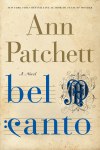
Bel Canto: A Novel by Ann Patchett, 5/5
This exquisitely written character study of a group of hostages and their guerilla captors is effortlessly beautiful and surprisingly well paced, given the confined context provided by the story’s extreme constraints with regard to location and plot. Like a poet adhering to a particular rhyme scheme, the author works within these constraints to explore the inner workings and relationships of a seemingly disparate cast, including a world-famous soprano, her most devoted admirer, rebel generals, child soldiers, assorted international businessmen, and the translator whose language skills link them all together.
Why I read it: I encountered a glowing review on Facebook, which was almost definitely, in retrospect, written by AI.
The Ultimate Gift

The Ultimate Gift: A Novel by Jim Stovall, 1/5
Sometimes, you can judge a book by its cover. Preachy, predictable, and poorly written, this novel is pretty much rock bottom in terms of literary quality.
Why I read it: trying to stay open-minded and this was passed along in a box of random books from a friend.
Mind Gym

Mind Gym: An Athlete’s Guide to Inner Excellence by Gary Mack with David Casstevens, 1/5
Determined to develop a healthier mental approach to martial arts competition, I started this book with an optimistic attitude and pencil in hand, committed to completing every exercise and buying into the inevitable inspirational cliché or few. How unprepared I was for the relentless barrage of banalities I would encounter! Every exercise (and they were exceptionally few) was eye-rollingly familiar and the text was a hodgepodge of quotes and borrowed anecdotes that descended into the utter madness that can be found on page 198…
So what happens on page 198? Well, firstly, the author states that “His [Kurt Warner’s] bags-to-riches story is as inspiring as the song I play for athletes at the end of every training session. The song, by Mariah Carey, is titled Hero.” … Let’s take a moment to process that statement. A legitimate counselor of sports psychology habitually inflicts a Mariah Carey song on his clients for its raw motivational power? Really? Every training session? That song? Do they sit there with eyes closed for the full 4 minutes, absorbing all that sweet 1990s inspiration, or does it play on his phone as a sort of alarm to mark the end of a session, or is it background music for a hasty exit? The more you think about it, the less sense it makes. And the less sense it makes, the more it starts to throw into doubt literally everything else the author has to offer.
Just two sentences later, the unfortunate reader encounters this clunker of a paragraph: “Competitive sports can bring out the best in people. Instead of playing small, they overcome their self-doubts and fears. They let their light shine. They find courage, which is the opposite of discourage, and tap into their reservoir of potential. Reflect a moment.” The author means for us to reflect on moments of personal heroism, but instead, let’s focus on the much more interesting question of how the phrase “courage, which is the opposite of discourage” made it into print.
By the end of this book, I had lost so much faith in author Gary Mack that I became curious about his academic qualifications (conspicuously absent from the author bio). From his obituary, I learned that he did earn a Masters of Counseling Psychology, but what I find far more impressive is that he built a credible career in that field without have a single original thought! Perhaps it is a common failing, though. The next sports psychology book in my to-read pile (Champion’s Mind) was written by a PhD, yet peeking out from under the dust jacket flap is a note from a fellow, disillusioned library user: “Terrible–a bunch of slogans strung together by poor writing. Skip this.” Thank you, kind stranger. I shall.
Why I read it: lent to me by a gym friend.
Convoluted Universe
 Convoluted Universe: Book One by Dolores Cannon, 1/5
In retrospect, I should have known better than to attempt to read a book on any topic written by a self-proclaimed “investigator into the paranormal through the use of hypnosis.” However, I succumbed to the back cover’s tantalizing promise of “metaphysical ideas that border on quantum physics,” thinking that perhaps the old saying it’s the message, not the messenger, was applicable. Alas, I was too optimistic.
In the interest of fairness, I persevered through 113 punishing pages of unmitigated nonsense, presented in the form of interview transcripts with two hypnotized women. The first woman claims to have been a medieval prince in a past life, who was taught the “real” history of earth by an extraterrestrial being. Her story focuses on intergalactic political intrigue and alien visits to earth throughout history, during which they supposedly imparted knowledge and intermingled with humans. There is nothing remotely plausible about these outlandish ideas, which read like standard sci-fi fare, presented in a tedious Q&A format.
Even poorly written sci-fi was more bearable than the interviews with the second woman, who does an absolutely terrible job of pretending to channel alien beings. Her acting is cringe-worthy and she artlessly strings the author along in an attempt to obscure the fact that she has nothing of value to communicate. Here’s an example from pages 99 and 100:
D: Are you listening to someone?
J: (Her voice sounded more normal.) Yes. It’s somebody that wants to speak to you, but they can’t talk English, and I can’t talk that. And we’re trying to figure out how to do it.
D: Can they have someone else communicate it?
J: They’re looking. They’re talking. They’re having a little discussion. They’re in the corner. It’s like they’re trying to decide.
D: Tell them we’re running out of time here. I really want to get the message, because they were giving me instructions. (Confusion) Maybe they can relay it to someone else who can give me the message.
J: That’s what they’re doing. (Softly, as though talking to someone else.) Okay. (Big sigh.)
D: Are they ready now?
J: (Another louder voice.) Perhaps.
D: Because I have no way of knowing if I’m breaking any regulations, if they don’t instruct me.
J: (She started to talk, then cleared her throat, as though the being had to adjust to her vocal cords. The next voice was definitely feminine and softer.) There have been no regulation violations. But we would caution you to be extremely careful in your casual discussions of the phenomenon. You must be careful with whom you share casual information. There are sensitive areas. It is important, I repeat, just casual information and sharing is not allowed. You have done well, and we are thankful. One of the problems could be the nature of the information, and the timing. It is not a matter for everyone to know everything. You are very good at being able to determine who should know what. That is a level of your expertise that allows us to work with you well. It is not a matter of trusting or not trusting you, as much as it is a matter of timing. Time to know, time not to know. So, whenever you are given information in the future there will sometimes be instructions not to divulge it, until you are given further instructions. Perhaps you can find a way if it is necessarily crucial to something on which others are working, to advise them. But do not divulge your source. We will be orchestrating their knowledge, so that anything that is shared with others will be of a nature that it is preapproved.
Throughout, the author does not seem concerned with establishing even the pretense of plausibility and her interview techniques are atrocious, clearly meant to assist her subjects in their inventions. The so-called secrets of the universe that these women are meant to possess are nothing but sci-fi cliches and it is telling that, in both cases, the women made great efforts to get in contact with and work with Cannon, who made herself available to them only sporadically. If, as she claims, Cannon was receiving “lost knowledge” and “allowed to have the answers to any questions [she] wished to ask” from these women, it is odd that she was unwilling to go out of her way to meet with them, and prioritized speaking engagements and mundane entrepreneurial activities over receiving information that, if true, would be of infinite value.
All of this might lead you to wonder, as I did, how such a ridiculous book could come to be published. It turns out that the author literally started her own company (Ozark Mountain Publishing) because no one else would touch her work. The fact that she was forced to go to such lengths would be an encouraging statement about the survival of common sense amongst readers, if it weren’t for the fact that, for some inexplicable reason, Cannon managed to develop a following of people who took her seriously and continue to propagate her bat-shit crazy legacy even after her death.
Why I read it: It came up in conversation with my massage therapist.
Seabiscuit
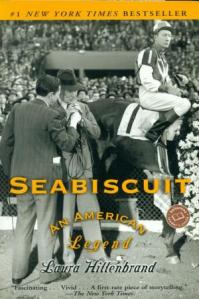 Seabiscuit: An American Legend by Laura Hillenbrand, 4/5
This true story wasn’t quite as readable as I’d expected, having been absolutely blown away by Hillenbrand’s later work Unbroken. I was partly to blame for approaching the book with a skepticism that made me look disconsolately for footnotes where there were none. For some reason, I just couldn’t escape the nagging question “does she really know what all the people in her story said and felt, or is she just making it all up?” I would have had a much more enjoyable experience if I’d read the end notes, acknowledgements and interview with the author at the end of the book first. These sources helped me realize the insane amount of time and energy Hillenbrand, already an accomplished equestrian author, put into researching the story of Seabiscuit.
I just have to point out how bizarre it is that the horse’s face didn’t make it onto the cover of the book! Even the image on the spine is of the jockey, not his famous steed.
Why I read it: I was looking for something light to read while traveling and Seabiscuit had been on my radar for quite a while.
Elmore Leonard’s 10 Rules of Writing
 Elmore Leonard’s 10 Rules of Writing by Elmore Leonard, 4/5
It’s a bit backwards that a short essay about writing is my first introduction to this author, however Leonard’s fascinating goal to “remain invisible” in his writing and the many similarities between his philosophies and those of screenwriter William Goldman, make me very eager to read more by him.
Why I read it: I very much enjoyed the TV show Justified, which was based on some of Leonard’s short stories. The show’s dialogue was especially good, so I am curious how much of that is a reflection of the source material (judging from this essay, I’m guessing a lot). Also, in researching Leonard, I found that his novels have been the inspiration for many movies, such as Mr. Majestyk, 3:10 to Yuma and Jackie Brown, which makes him even more interesting.
Democracy–The God That Failed
 Democracy–The God That Failed: The Economics and Politics of Monarchy, Democracy, and Natural Order by Hans-Hermann Hoppe, 2/5
This series of essays starts out strong, with the author daring to question the hallowed concept of democracy and finding it severely lacking in several easily demonstrable ways. However, common sense and strong opinions can only take you so far when it comes to formulating complicated theories of politics and economics. As Hoppe’s ideas became more and more bizarre, I became increasingly angered by his failure to provide convincing supporting arguments or hard data of any kind. I couldn’t figure out why an obviously intelligent academic would present his opinions so insultingly, through shallow reasoning, cheap rhetoric and gross oversimplification. After quite a lot of teeth gnashing, I finally realised the problem was identified right in the first sentence of the book’s introduction: the essays were originally speeches written for Libertarian conferences. The whole point was to fire up sympathetic audiences, not necessarily to convince anyone of anything. I wish I’d known this ahead of time, because maybe then I’d have been spared the prospect of Hoppe’s horrifying “solution” to the problem of democracy: an “anarchic” private law society, overseen by military-grade private insurance corporations.
[Why I read it: it came up in conversation with my brother.]
 OmniRambles