The Empty Core

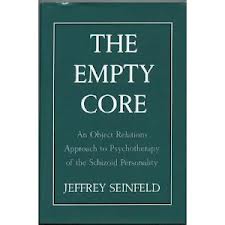
The Empty Core: An Object Relations Approach to Psychotherapy of the Schizoid Personality by Jeffrey Seinfeld, Ph.D., 4/5

At first, the opacity of many sections of this book tempted me to take back my criticisms of the much simpler Split Self/ Split ObjectThe first chapter of this work, a short overview of object relations theory, could be the basis for an entire college course.  Fortunately, the case examples made the technical material bearable and I find myself understanding much more as I look back over the content.  Since this book is both difficult to understand and difficult to obtain (I had to get it through a two-week inter-library loan), I am writing a longer, more detailed review in order to help myself process and remember certain aspects of the book.

The title references a concept that I did not find easy to grasp at first, but later resonated with completely – the “empty core.”  Seinfeld describes the schizoid experience of the empty core as “the uncrossable divide between the external and internal object worlds” (10).  Since “instinctual drives are not complete in themselves but create, in the individual, a need for something external; they embody a sense of incompletion and lack” (8).  One strategy schizoids use to cope with this feeling is “the effort to eliminate all need by maintaining himself as aloof, self-sufficient, isolated.  Emptiness becomes an ideal.  The individual strives toward extinguishing all need” (14).  This sounds like someone I know and love…

Another concept in this book that I found fascinating and insightful is the idea that, as infants, we only experience ourselves through other people – seeing our reflection in them, which explains the human need for privacy:

“In existential phenomenological terms, the infant discovers its true self, which includes biological temperament, cognitive capacity, appearance, through the response of the other.  The infant therefore discovers itself in the mode-of-being for others (Sartre 1943).  The conception of being-for-others is analogous to the Kleinian idea of the infant becoming incorporated by the other and gives rise to comparable anxieties.  In being for the other, the infant becomes aware of a lack of being-for-itself.  It sees itself in its otherness, as object to the other’s subjectivity and endeavors to wrest back its subjectivity by the desire to flee from the sight of the other.  To become invisible, to be unseen, is to annihilate one’s reflection in the eye of the other.  This is the origin of the need for solitude and privacy, to make oneself into something more than what others perceive one to be” (37).

Reading this book did not consist entirely of “aha” moments of insight and clarity.  For every compelling idea offered, there were paragraphs positively reeking of B.S., especially much of the content related to infant psychology and the mother/father as objects.  I am aware that Seinfeld’s main purpose was to outline, not defend object relations theory, but many of the quotes and ideas he used came across outlandish, unscientific and unsupported.  I was unsurprised to find Freud’s name and that of his followers connected to many of these theories.

Overall, though there was much that I disagreed with or didn’t understand in this book, it did reward my mental effort with some thought-provoking ideas and insights.

Split Self/ Split Object

Split Self/ Split Object: Understanding and Treating Borderline, Narcissistic, and Schizoid Disorders by Philip Manfield, Ph.D., 3/5

Knowing nothing about clinical psychology at the outset, I was surprised by how accessible this book, geared towards an audience of professional therapists, turned out to be.  The language was not technical and the concepts seemed simplistic.  Because of this, I have split feelings (haha) about it;  on one hand, it was enjoyable to gain an understanding of general psychology concepts, but on the other hand, I was shocked that any practicing clinician would need a book this basic.

No matter what Manfield’s approach might suggest about the competency levels of some therapists, I read this in an attempt to gain the tools to understand myself a little better and it was a successful experience.  Until now, my understanding of psychotherapy consisted of something vague about people who think they’re smart, generally wear glasses on the tips of their noses, scribble meaningfully on notepads while muttering tut tut and claim couches as business expenses.  Now, I understand better that a therapist’s job is more to direct their client’s self-analysis than to intervene.  My conclusion?  Making people think is cool.  Making yourself think is cooler.  Challenge accepted.

Short and Sour

Synonym Poems

Inspired by Alison Bernhoft.

An Unscrupulous Used Car Salesman
He’d sell you a rusty dustbin on wheels
And claim it’s the very sweetest of deals.

News
“FEAR, FEAR, DEATH and LIES”
Each front-page headline loudly cries.

Dylan Moran
A tousled frown, a tipsy grin –
This Irishman’s as fun as sin.

Work
If only activities occupational
Could somehow be more recreational.

Writer’s Block
A glowing page of purest white,
This Word file is zero kilobytes.

Pothole
I see a cavern gaping wide
And steer my tires on either side.

J.S. Bach
A musician fanatical
Writing music mathematical.

Night Owl
I stay up early and wake up late;
Before noon my brain can’t computate.

Our Dog, Frank
With his mix-and-matched looks and a need for sedation
It’s no wonder he’s named after Shelley’s creation.

Ten
Twice five is the number of fingers and toes
And the year Wang Mang outlawed the use of crossbows.

Unbroken

Unbroken: A World War II Story of Survival, Resilience, and Redemption by Laura Hillenbrand, 5/5

Several people recommended this book to me, so naturally, I expected it to suck (following the observable and direct correlation between popularity and shitness… *ahem* 50 Shades of Grey, Twilight *ahem*).  Given this [realistic, not pessimistic] expectation, I was first surprised to find myself not hating the beginning chapter, then shocked to find the rest of the book to be an extremely enjoyable page-turner.  Not only does the story have enough drama and action for four movies, but it is based on a true account and is written sensibly.  Hillenbrand doesn’t waste the reader’s time or make loads of obnoxious speculations about characters’ subjective feelings.  The book is well-formatted, with pictures placed strategically throughout instead of in annoying inserts.  The last time I was this surprised to love a book was War and Peace.

Lose It!

Lose It! by Charles Teague and Anahad O’Connor, 1/5

I love the Lose It! website (it’s helped me lose 30+ pounds) but this book has little to recommend itself.  The info it provides is shallow and repetitive.  The whole eat-a-normal-hamburger-every-day-instead-of-a-supersized-cheesy-one-and-you’ll-save-enough-calories-in-a-year-to-lose-5-pounds method of weight loss is not very convincing or motivating to me.  The only reason to buy this book would be to support the free app and website.  Everything you need to know can be found on the website, in the forums.

Ghostwritten

Ghostwritten by David Mitchell, 3/5

Sadly, this book is not written by British comedian David Mitchell, but by a less funny and much less sarcastic man of the same name.  Nevertheless, I persevered in my reading because these very personal stories, narrated from the viewpoint of nine different individuals, are well-written, with a voyeuristic appeal.  I admire how Mitchell gently weaves the accounts together, letting the reader discover the characters and events in common between them, instead of belaboring the connections.  The main reason I didn’t give this book a higher rating is that I am unable to understand what the point of the whole thing is (and it’s not just that I’m too thick to “get” it – other reviewers seem equally unenlightened and even the book jacket was very vague in its description).  The novel has the effect of a garment, beautifully embroidered and carefully sewn together, that cannot be worn because its random openings and panels don’t fit the human body.

Hamlet (2000)

Hamlet movie 2000

aaaaaaaaaaaaaaaAAAAAAAAAAAAAAAA!!! Almereyda’s Hamlet (“starring” Ethan Hawke) is one of the most atrocious films I have ever seen! How in the name of all that is holy did this movie win awards and get mixed reviews? Don’t even get me started on its portrayal of the play, which is heart-wrenchingly, mind-crushingly deficient. No, my complaints are much less subjective.

For example, someone forgot to inform the actors that Shakespeare left spaces between the words, so mostofthelinessoundlikethisbutdeliveredwayfasterthanyou’rereadingrightnow. The cameraman seemed to be using his elbows to maneuver the camera. The b-roll footage appeared to be lifted from an entirely different movie by an editor with ADD. Right at the beginning, there is a speech dubbed over video of an actor who is obviously forming completely different words with his mouth. The visuals were cluttered, the sets sloppy, the shot compositions senseless and the staging horrendous (examples: action cramped awkwardly into the half of the frame that isn’t being taken up by a curtain, dialogue where one person’s head completely blocks the view of the other person’s… I could go on, but I don’t have 72 minutes like the director of this hideous film did).

But the most original, startling, thought-provoking performance of all was from that boom mic, yes an entire boom mic, that reflected boldly off a window and right into my narrowed, unbelieving, pained eyes. In the director’s inept hands, the characters’ [usually tragic] deaths were mercy killings that finally released both them and me from the textbook enactment of film gaffes that is Almereyda’s Hamlet.

The Third Eye

The Third Eye: The Renowned Story of One Man’s Spiritual Journey on the Road to Self-Awareness by T. Lobsang Rampa, 1/5

I quit.  The author’s forward to the second edition, with its fishy protestations of innocence and honesty made me suspicious initially.  26 pages containing bizarre descriptions of Tibetan culture later, I finally Wikipedia-d the book and learned that T. Lobsang Rampa is actually Cryil Henry Hoskin, a very British, very crazy man who must have suffered an immensely boring life before becoming the host of a Tibetan monk’s spirit.  I could think up more scathing things to say, but really, a man who has had a book dictated to him by his Siamese cat (Living with the Lama) obviously needs no further comment.

Words Like Loaded Pistols

Words Like Loaded Pistols: Rhetoric from Aristotle to Obama by Sam Leith, 4/5

Leith achieves a great balance with this book – he’s entertaining without being insulting, academic without being dry and analytical without being annoying.  Where other writers might exhaustively dissect a piece of rhetoric at the cost of common sense and the reader’s patience (see How to Read Literature Like a Professor), Leith keeps his analyses to-the-point and useful.  Less importantly, I enjoyed the English pop culture references – it was fun to see mentions of TV shows and celebrities that I love, but don’t get to share with anyone here.