The Man Who Never Was

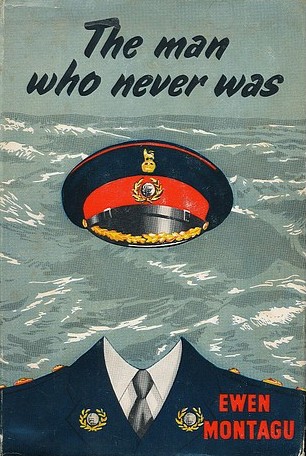
man who never was2The Man Who Never Was by Ewen Montagu, 4/5

This is the definitive and first-hand account of a real-life wartime deception that bears more similarity to a fictional spy/thriller story than to reality.  During WWII, the author was in charge of a scheme to float a corpse bearing falsified military papers off the coast of Spain, in an attempt to trick the Germans into diverting resources from the impending Allied invasion of Sicily.  The narrative is simply-told and well-illustrated with numerous photos.

[Why I read it: the retro design on the spine caught my eye at the thrift store and I was somewhat familiar with the historical event the book describes so I bought it for my brother’s library.]

The Four Adventures of Richard Hannay

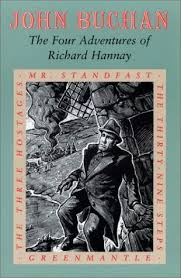
four adventures of Richard HannayThe Four Adventures of Richard Hannay: The Thirty-Nine Steps, Greenmantle, Mr. Standfast and The Three Hostages by John Buchan, 4/5

I have long considered The Thirty-Nine Steps, Buchan’s first (and shortest) Hannay novel, to be good clean fun.  It is a thrilling spy tale that is elegantly implausible and crisply confident, standing up well to multiple re-readings.  Of the following three novels, I thought The Three Hostages to be closest in style and would give both it and the first story a solid 5/5.

The two middle novels fall off somewhat – both are sprawling stories, full of dry details and unnecessary tangents, while the second suffers from its ham-fisted treatment of the romantic subplot (for which failings I would rate them 3/5).  Still, it was fun to become better acquainted with self-deprecating, ex-mining engineer Richard Hannay, part-time spy and full-time war hero.

[Why I read it: it got on my radar when I saw my brother reading it, especially since I was already a fan of the first novel.]

Wordstruck

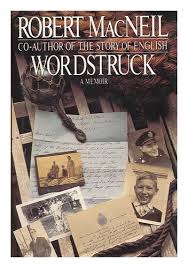
wordstruckWordstruck: A Memoir by Robert MacNeil, 2/5

MacNeil is obviously a highly successful and intelligent man (to judge from his Wikipedia article and contributions to The Story of English) but this memoir is very dull and would, I think, be of little interest to anyone not actually related to him.  Perhaps it suffers from too much humility in the presentation or perhaps it’s just that people who write more exciting memoirs tend to lie a lot.

[Why I read it: it was a present from my mom and I liked MacNeil’s work in The Story of English].

King Solomon’s Mines

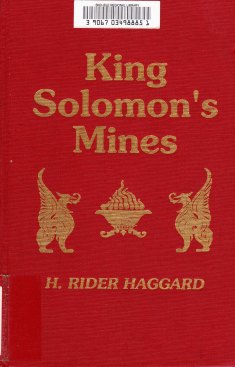
king solomonKing Solomon’s Mines by H. Rider Haggard, 4/5

An exciting adventure story that’s written with an abundance of wit and charm, though unfortunately suffering from an equal abundance of nonchalant 19th century racism.

[Why I read it: my brother read me a couple hilarious excerpts from it.]

Steal This Computer Book 2

steal thisSteal This Computer Book 2: What They Won’t Tell You About the Internet by Wallace Wang, 1/5

This 2001 version is hopelessly outdated and consists mostly of very generic info and URLs.  The little of interest it has to offer is purely archival – references to and screenshots of old-school websites and software.  Wang seems to lack the qualifications necessary to write a truly informative book or to live up to his self-styling as a sort of tourist guide to the hacking subculture.  His muddled philosophising on politics/ethics does not camouflage what is a blatant attempt to capitalise on the pop-culture appeal of hacking.

My favourite quote from the book is this gem: “…assume that any strange music coming from your computer is from a virus” (227).

[Why I read it: the title caught my eye in the thrift store.]

Mafia!

mafia2Mafia! by Fred J. Cook, 3/5

For once, the commendatory cover quote on a cheap paperback is accurate!  While the book is entertaining and does indeed read like a novel, it is unfortunate that, lacking sources, citations and notes of any kind, it also tends toward the credibility of a novel.

The thing I was most shocked to learn was the fact that upper-class society doesn’t care about morals as long as a person is personally attractive, charming and has plenty of money and power.  Perhaps this seems obvious to others, but I could hardly believe the amount of hobnobbing with evil, murdering gangsters that was (and still is, I’m sure) done by celebrities, politicians, and respected businessmen.

[Why I read it: it was a random thrift store find and I admit I partly bought it because of all the fedoras being worn in the vintage photo illustrations inside.]

Understanding X-Rays

understanding x-raysUnderstanding X-Rays: A Plain English Approach by Mikel A. Rothenberg, M.D., 3/5

Apparently, “plain English” is not-so-plain-English for the most baffling presentation of puns and random clip art I have ever seen published.  At the bottom of this post are three of the more traumatising pages in the book.

Despite the format, there is still some valuable info and I enjoyed the more sensible sections, especially the case studies at the end.  Even with my lack of medical knowledge, however, the scope of the book felt very narrow and simplistic.  I could see it being well-used as a supplement for a class, but it definitely left me wanting more information.

[Why I read it: I became interested in the topic through my frustration at not being able to make much of my friend’s Lisfranc dislocation x-rays.  I saw that this book had good reviews on Amazon and likely wouldn’t be too far over my head, so I ordered it through interlibrary loan.]

UnderstandingX-raysimage

The Rorschach Technique

rorschachThe Rorschach Technique: An Introductory Manual by Bruno Klopfer and Helen H. Davidson, 2/5

After a few pages containing a dizzying number of acronyms, diagrams and guidelines, I soon realised that there is more to the Rorschach than simply labeling someone as disturbed because they saw a scary face and blood stains in an ink blot.  Interestingly, the Rorschach is not actually a test at all, but a method, purportedly providing valuable psychological info through analysis of the subject’s reaction to and interpretation of 10 different ink blot cards.  While the method is admirably complex, I was disappointed that the book focuses more on administering and interpreting the Rorschach than establishing its legitimacy in the first place.  Being assured that “the meanings attached to the scores…possess clinical rather than experimental validity” does little to allay my native suspicion (128).

My low rating of this book is based on the fact that it is outdated (from 1962), does not adequately establish the Rorschach’s validity and provides only black and white depictions of the cards.

[Why I read it: random thrift store find.  I wanted to learn more on the topic, since I suspected that popular culture’s perception of the Rorschach was flawed.]

George MacDonald: An Anthology

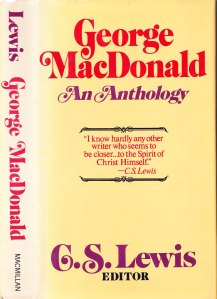
George Macdonald cropGeorge MacDonald: An Anthology, ed. C.S. Lewis, 4/5

While Macdonald’s Phantastes is one of the best fantasy books I’ve ever read and I enjoyed the Curdie books as a child, I’ve never been a fan of his other novels and was not particularly looking forward to reading this anthology. Just as it feels wrong that I love Bach but not his favourite instrument, the organ, so I always thought it felt wrong to love C.S. Lewis and not George Macdonald, one of Lewis’s most-loved inspirations.  Happily, the issue is cleared up in the preface, where Lewis calls the Macdonald books I happen to like “the great works,” while admitting that “necessity made MacDonald a novelist, but few of his novels are good and none is very good” (xxix).  The rest of the preface provides an excellent discussion of mythology, which would make the book a must-read in any case.

Each of the 365 excerpts presented in this collection is worthy of a day’s reflection and reading the whole book in one go felt rather like going to a dinner buffet that only serves steak.  There is an aura of the commonsense and uncompromising, softened by the humility and gentleness that should be the defining characteristics of every Christian.  Some of my favourite quotes were the ones on spiritual “dryness,” where MacDonald points out that the firm foundation on which our faith is built cannot be shaken by changing emotions and feelings:

That man is perfect in faith who can come to God in the utter dearth of his feelings and desires, without a glow or an aspiration, with the weight of low thoughts, failures, neglects, and wandering forgetfulness, and say to Him, “Thou art my refuge” (1).

Troubled soul, thou are not bound to feel but thou art bound to arise.  God loves thee whether thou feelest or not.  Thou canst not love when thou wilt, but thou art bound to fight the hatred in thee to the last.  Try not to feel good when thou art not good, but cry to Him who is good.  He changes not because thou changest.  Nay, He has an especial tenderness of love toward thee for that thou art in the dark and hast no light, and His heart is glad when thou doest arise and say, “I will go to my Father.” …Fold the arms of thy faith, and wait in the quietness until light goes up in thy darkness.  For the arms of thy Faith I say, but not of thy Action: bethink thee of something that thou oughtest to do, and go to do it, if it be but the sweeping of a room, or the preparing of a meal, or a visit to a friend.  Heed not thy feeling: Do thy work (18).

N.B. Most of the book is not written in the old-timey, King James Version speech.

[Why I read it: given to me as a birthday present by my parents.]

Letters to an American Lady

letterstoanamericanLetters to an American Lady by C.S. Lewis, 4/5

If it is possible for my admiration of C.S. Lewis to increase any more, then it has done so through reading this collection of his letters, written over a span of thirteen years, in response to a needy old lady who, far from being his intellectual equal, seemed to be somewhat shallow and quite focused on her own numerous troubles.  The graciousness, care, wisdom and kindness with which he writes can only come from God and are perhaps an even more powerful witness to me of God’s transforming power than anything more intellectual that Lewis could have written.

[Why I read it: given to me as a birthday present by my parents.]