
Category: Reviews
No Man Is an Island
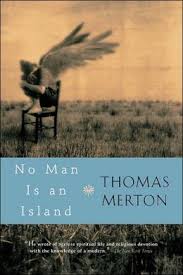 No Man Is an Island by Thomas Merton, 3/5
At first, I thought this collection of thoughts on 16 different spiritual topics was reasonably profound and insightful. It wasn’t until Merton started saying, with blithe confidence, things I doubted or disagreed with that I missed the intellectual underpinnings characterising the likes of C.S. Lewis and G.K. Chesterton. Merton’s unintellectual approach to spiritual matters is made palatable by his eloquent writing skills, perhaps dangerously so. Those who approach this book wishing to be told what to think could quite possibly be led into error, but those who have already given thought to such topics will likely recognise much truth in what he says.
[Why I read it: the title is appealing and seemed relevant to my life at the moment. I originally thought the phrase “no man is an island” came from this book, but it actually originated in a poem by the 17th-century poet John Donne. Interestingly, from the same short poem comes the phrase “for whom the bell tolls.”]
Raising Steam
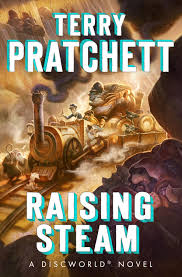 Raising Steam by Terry Pratchett, 3/5
I love the first book in the Moist von Lipwig series, Going Postal, but felt this latest addition was sadly lacking. It is a testament to Pratchett’s original genius that a book achieving about 50% (in my mind) of his usual plot, wit and charm could still be a 3-star book.
[Why I read it: I’m a huge fan of classic Pratchett.]
Hyperbole and a Half
 Hyperbole and a Half: unfortunate situations, flawed coping mechanisms, mayhem and other things that happened by Allie Brosh, 4/5
Brosh’s blog is without doubt one of the funniest things I’ve ever seen, but the book format didn’t really work for me. I feel that her hilarious stories are meant to be scrolled through, not read at the rate of two panels and a paragraph per page, and her weirdly expressive artwork suits the computer screen best, in my opinion. Also, there is soooo much swearing. Usually, I’m a fan of expletives used for comedic purposes, but I guess I don’t like seeing them in print. In action movies: great. TV shows: fine, if it’s clever. Online content: ditto. Books: no thank you I can’t believe they typed that my eyes are burning.
[Why I read it: I love the blog.]
The First and the Last
 The First and the Last: The Rise and Fall of the German Fighter Forces, 1938-1945 by Adolf Galland, translated by Mervyn Savill, 3/5
This memoir by Adolf Galland, a German fighter pilot and Luftwaffe General of Fighters during WWII, is undoubtedly an invaluable resource for the student of history, but I did not find it to be written in a particularly engaging manner. The parts I found most interesting were those describing Galland’s personal encounters and conflicts with Hermann Göring and Hitler, with whom Galland had major disagreements over policies that focused on bombers to the detriment of the fighter wing, handicapped fighters by forcing them to operate defensively instead of offensively, and spread the air force’s assets too thinly. Of course, Galland comes off rather well in the memoir, so it is difficult to tell what is accurate and what is embellished in retrospect (whether purposefully or not).
Like many others, I presume, my exposure to WWII was mostly of the sanitized, black and white version found in history textbooks. It was thought-provoking to see the war from a different, more morally-ambiguous point of view. Galland did not seem to experience any moral conflicts regarding Hitler’s actions; he may have doubted his führer’s method of conducting the war, but he didn’t raise any concerns about Hitler’s ideology. Except in the case of his under-trained fighters being sent out on what amounted to suicide missions, his mindset was very much that of a faithful cog in the war machine, as was the case, I suspect, with the vast majority of people who fought and died for the Axis.
When I think of civilian casualties during WWII, the first thing that comes to mind is the London Blitz. That chapter of England’s history is not unduly disturbing to me because 1) I [incorrectly] picture everyone hiding in bomb shelters while empty buildings take the brunt of the violence and 2) the Germans were the baddies and thus could be expected to target the civilian population. This naive point of view was shattered when I read Galland’s account of the Allied bombing of German cities, in which hundreds of thousands of German civilians were killed (including thousands of children). I always pictured collateral damage occurring only in the course of bombings of war factories and industries vital to sustaining the war effort. I never pictured the “Good Guys” taking off to purposefully destroy cities and centers of culture, filled with normal people. It’s always been my unthinking opinion that if a country is at war, it’s civilians are at war too, but this first-hand account was hard to stomach.
[Why I read it: my sister enjoyed it first.]
New Watch
 New Watch by Sergei Lukyanenko, translated by Andrew Bromfield, 4/5
I enjoyed this most recent addition to the Watch Series, told from the now-familiar perspective of Anton Gorodetsky. The author was successful in bringing in some new ideas/elements, though I did get a bit lost at the end of the story and had to consult Wikipedia.
[Why I read it: I’ve mostly enjoyed this series, starting with the first book, Night Watch.]
Last Watch
 Last Watch by Sergei Lukyanenko, translated by Andrew Bromfield, 3/5
For some reason, I didn’t enjoy this book as much as the previous one. Perhaps some of the premise’s novelty has worn off for me, or perhaps the storylines just weren’t as engaging. I felt that Lukyanenko tried a bit too hard to include pop culture/literary references and I was annoyed by his appropriation of Merlin as a story character. The writing was decent, though there was some clumsiness in the first few pages that actually made me stop to check if the translator was the same person (it was). I didn’t appreciate the racy content, but it was nowhere as bad as Day Watch. Overall, a somewhat meh experience, but I’ll still be reading the fifth book in the series, as soon as it comes in at the library.
[Why I read it: I’ve been reading this series off and on over the last couple months, starting with Night Watch.]
The Long Dark Tea-Time of the Soul
 The Long Dark Tea-Time of the Soul by Douglas Adams, 5/5
This is one of the funniest novels I have ever read. Ever.
[Why I read it: I enjoyed the first Dirk Gently novel.]
The Prince
 The Prince by Niccolò Machiavelli, 4/5
This is not the tedious treatise on pure evil that I had been led, from Machiavelli’s diabolical reputation, to expect. Rather, it is a compact, logical description of what it takes to succeed as leader of a 16th-century domain. Though Machiavelli’s own political career does not really inspire confidence, he does support all his points with relevant anecdotes from both ancient history and then-current events. I also appreciate how he anticipates and addresses his critics’ objections, which is, to me, the hallmark of a well-formed argument.
Encountering the context surrounding much-quoted nuggets of apparent amorality, I am left with an impression, not of a mind of cunning evil, but one of keen observation. For the purposes of his academic study on political leadership, the proprietor of such an unflatteringly adjectivised surname is not concerned with what is right or wrong, but what is successful (success in this case being carefully defined, not as actions that will end you up in heaven, but actions that will enable you to retain control of a thriving domain). This is not because morality is unimportant to him (it is clear from the text that this is not the case), but because morality is simply not the focus of this particular study.
While I would fear to encounter a Machiavellian leader as a rival, I would not be unhappy to follow one, if only because it seems that those in power who do not appear Machiavellian are simply at a more advanced stage of deception.
[Why I read it: another of those oft-quoted, little-read classics.]
The King of Elfland’s Daughter
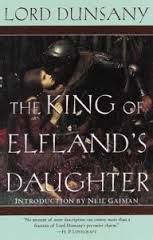 The King of Elfland’s Daughter by Lord Dunsany, 5/5
The story may be a little weak (especially at the end), but there is a beautiful bleakness to Lord Dunsany’s prose that reminds me of Tolkien’s Silmarillion; the most fantastic scenarios are presented with an earnestness that makes you believe for a magical second that you are reading history, not fantasy. I would place this tale in the same category as Mirrlees’ Lud-in-the-Mist and MacDonald’s Phantastes, but without their dizzying layers of allegory and meaning.
[Why I read it: Frustratingly, I can’t remember what led me to this book! All I recall is ordering it from the library for some reason…]
Summer Knight
 Summer Knight: A Novel of the Dresden Files by Jim Butcher, 3/5
I much preferred this plot’s faerie angle to the last book’s vampire theme and, as an added bonus: no love interest. I might have dropped a couple IQ points while reading it, but probably no more than would have evaporated after a couple hours of watching TV sitcoms.
[Why I read it: Partly because the fans promise the series gradually improves, partly because I’m not in the mood for serious literature right now and partly because I’ve come to view the Dresden Files as an old pair of stained sweatpants–not something I’d show off in public, but pretty all right for days of lounging around and eating junk food.]

