
Category: Book Reviews
The Prince
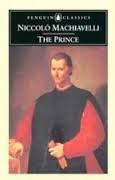 The Prince by Niccolò Machiavelli, 4/5
This is not the tedious treatise on pure evil that I had been led, from Machiavelli’s diabolical reputation, to expect. Rather, it is a compact, logical description of what it takes to succeed as leader of a 16th-century domain. Though Machiavelli’s own political career does not really inspire confidence, he does support all his points with relevant anecdotes from both ancient history and then-current events. I also appreciate how he anticipates and addresses his critics’ objections, which is, to me, the hallmark of a well-formed argument.
Encountering the context surrounding much-quoted nuggets of apparent amorality, I am left with an impression, not of a mind of cunning evil, but one of keen observation. For the purposes of his academic study on political leadership, the proprietor of such an unflatteringly adjectivised surname is not concerned with what is right or wrong, but what is successful (success in this case being carefully defined, not as actions that will end you up in heaven, but actions that will enable you to retain control of a thriving domain). This is not because morality is unimportant to him (it is clear from the text that this is not the case), but because morality is simply not the focus of this particular study.
While I would fear to encounter a Machiavellian leader as a rival, I would not be unhappy to follow one, if only because it seems that those in power who do not appear Machiavellian are simply at a more advanced stage of deception.
[Why I read it: another of those oft-quoted, little-read classics.]
The King of Elfland’s Daughter
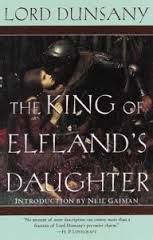 The King of Elfland’s Daughter by Lord Dunsany, 5/5
The story may be a little weak (especially at the end), but there is a beautiful bleakness to Lord Dunsany’s prose that reminds me of Tolkien’s Silmarillion; the most fantastic scenarios are presented with an earnestness that makes you believe for a magical second that you are reading history, not fantasy. I would place this tale in the same category as Mirrlees’ Lud-in-the-Mist and MacDonald’s Phantastes, but without their dizzying layers of allegory and meaning.
[Why I read it: Frustratingly, I can’t remember what led me to this book! All I recall is ordering it from the library for some reason…]
Summer Knight
 Summer Knight: A Novel of the Dresden Files by Jim Butcher, 3/5
I much preferred this plot’s faerie angle to the last book’s vampire theme and, as an added bonus: no love interest. I might have dropped a couple IQ points while reading it, but probably no more than would have evaporated after a couple hours of watching TV sitcoms.
[Why I read it: Partly because the fans promise the series gradually improves, partly because I’m not in the mood for serious literature right now and partly because I’ve come to view the Dresden Files as an old pair of stained sweatpants–not something I’d show off in public, but pretty all right for days of lounging around and eating junk food.]
Twilight Watch
 Twilight Watch by Sergei Lukyanenko,translated by Andrew Bromfield, 4/5
I’m glad I didn’t let the unlikeable second book in the Watch series put me off; this third book is very enjoyable and well written, back to the perspective of the original hero, Anton Gorodetsky.
[Why I read it: I’ve been reading this series off and on over the last couple months, starting with Night Watch.]
A History of Wales
 A History of Wales by John Davies, 3/5
There is a good reason why this massive book of almost 700 pages is not a very enjoyable read–it was originally written in Welsh for Welsh people and this English translation is merely a concession to popular demand. Davies is very thorough and efficient, providing one or two solid facts in every single sentence, but he doesn’t really make the topic interesting. I felt completely lost just a few hundred years in and failed to get a good overall grasp of Wales’ basic history. And, since I am not knowledgeable about Britain’s political parties, the last couple chapters were almost completely incomprehensible to me. Overall, the book is impressive in scope and makes a good reference, but contains too many details to foster a basic understanding of the topic and does not make the history come alive.
Davies’ portrayal of Welsh history is rather grim–full of poverty, oppression, strikes, and unemployment. While he is not critical of Socialism (which has historically been very popular in Wales), its application did not paint an appealing picture. Perhaps it is just the American in me, but I think I would rather be oppressed by a wealthy coterie of selfish capitalists than earn a government-mandated wage, working in a government-run industry and living in government housing.
Near the end of the book, I became curious about the relative size of Wales, both in area and population. I guessed it would have about as many people as California and cover as much land as Washington State. Shockingly, it turns out that Wales is about 1/9 the size of Washington and has less than 1/12 the population of California (that’s less than half the population of Washington)!
[Why I read it: it was a birthday gift in anticipation of a trip to Wales.]
Dirk Gently’s Holistic Detective Agency
 Dirk Gently’s Holistic Detective Agency by Douglas Adams, 4/5
The plot was kind of all over the place and the characters were not well-developed, but nobody’s funnier than Douglas Adams.
[Why I read it: I’m a fan of Stephen Mangan, who played the title character in a funny TV version of the book series which put the books on my radar.]
Lud-in-the-Mist
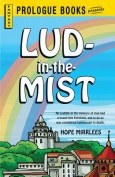 Lud-in-the-Mist by Hope Mirrlees, 5/5
This exquisite fantasy has a bittersweet and beautiful tune; I was entranced from the very beginning. More down-to-earth than George Macdonald’s Phantastes (one of the only books I can think of to which it is comparable), it expresses rather than evokes the mystery of human experience that C.S. Lewis describes as the “desire for our own faroff country” and the “inconsolable secret in each one of you” (The Weight of Glory).
Sadly, this atrocious edition is peppered with typos–even the front cover does not escape: in the book, residents of Lud-in-the-Mist are referred to as “Ludites,” not “Luddites.” Never did a typo bring along so many unfortunate and completely unrelated connotations.
[Why I read it: It appeared in very good company in the article “10 Forgotten Fantastical Novels You Should Read Immediately.”]
Daywatch
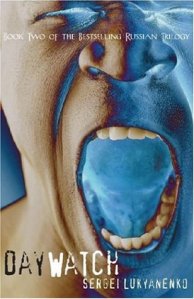 Day Watch by Sergei Lukyanenko, translated by Andrew Bromfield, 3/5
I really like the world Lukyanenko has created for this series, but a really graphic sex scene and lack of empathetic characters made this book less enjoyable than the first book in the series and one that I couldn’t really recommend.
[Why I read it: the first book in the series, Night Watch, was extremely well-written.]
Frank Skinner
 Frank Skinner by Frank Skinner, 4/5
This autobiography is very funny and very dirty but not often, to my taste, both at the same time. Despite the “knob jokes,” I quite enjoyed the casually-disorganised, friendly tone of the book and the inside view of a man who, contrary to his on-stage persona, seems more artist than arsehole. Skinner’s self-deprecating but jubilant views on success and fame were entertaining without being alienating and his self-conscious defensiveness about his Roman Catholic faith was refreshing.
[Why I read it: I have always enjoyed Skinner’s panel show appearances on the likes of Have I Got News for You, QI, and Would I Lie to You,but didn’t know he’d written a book until Scottish comedian Kevin Bridges cited it as his inspiration to become a stand up comedian. I found a free sample online of the first few pages and lost it at this part:
When I still lived in Birmingham, I dated a stunningly attractive woman. I had been seeing her for about three weeks when I finally asked her where she lived. It turns out she dwelt in what was, at the time, a very rough block of flats called Bath Court. I said, in what I felt was a slightly Wildean tone, ‘The trouble with Bath Court is that the residents spend a good deal more time in the latter than they do in the former.’
‘Where’s “The Latter”?’ she asked. I knew then that our love could never flourish. (6)
My library wouldn’t buy it for me (some bollocks about it not being available in the U.S.), but there was a copy in the first Waterstones book store I wandered in to in London.]
Frankenstein
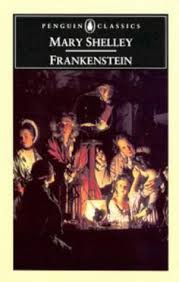 Frankenstein: or, The Modern Prometheus by Mary Shelley, 4/5
Oooohhhhh, that “Shelley“! was my first and strongest reaction to this book. Frankenstein is well-written and maintains suspense throughout, but hinges, I thought, on a couple unconvincing plot devices: Frankenstein’s unwillingness to have a proper conversation with his monster and the monster’s quick descent into violence, neither of which made much sense to me.
[Why I read it: Another classic, like Dracula, that I should have read ages ago and finally picked up at the thrift store.]
 OmniRambles