
Tagged: history
A History of Wales
 A History of Wales by John Davies, 3/5
There is a good reason why this massive book of almost 700 pages is not a very enjoyable read–it was originally written in Welsh for Welsh people and this English translation is merely a concession to popular demand. Davies is very thorough and efficient, providing one or two solid facts in every single sentence, but he doesn’t really make the topic interesting. I felt completely lost just a few hundred years in and failed to get a good overall grasp of Wales’ basic history. And, since I am not knowledgeable about Britain’s political parties, the last couple chapters were almost completely incomprehensible to me. Overall, the book is impressive in scope and makes a good reference, but contains too many details to foster a basic understanding of the topic and does not make the history come alive.
Davies’ portrayal of Welsh history is rather grim–full of poverty, oppression, strikes, and unemployment. While he is not critical of Socialism (which has historically been very popular in Wales), its application did not paint an appealing picture. Perhaps it is just the American in me, but I think I would rather be oppressed by a wealthy coterie of selfish capitalists than earn a government-mandated wage, working in a government-run industry and living in government housing.
Near the end of the book, I became curious about the relative size of Wales, both in area and population. I guessed it would have about as many people as California and cover as much land as Washington State. Shockingly, it turns out that Wales is about 1/9 the size of Washington and has less than 1/12 the population of California (that’s less than half the population of Washington)!
[Why I read it: it was a birthday gift in anticipation of a trip to Wales.]
The Pacific
The Pacific by Hugh Ambrose, 1/5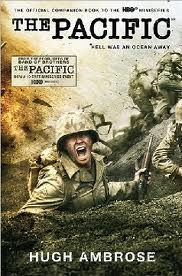
Some stories demand to be told, while others merely tolerate the telling. Unfortunately, most of this book seems to belong to the latter category. Ambrose’s attempt to follow his historian father’s success (who was involved with Band of Brothers and Saving Private Ryan, among other projects) comes off as extremely dry, forced and disjointed. Instead of weaving together the individual stories of WWII marines in a meaningful way, he jumps jarringly from one short scene to another, preventing the reader from developing any cohesive overall impressions. One small, but exceedingly annoying, example of Ambrose’s unpolished writing style is his inordinate fondness of the phrase “dribs and drabs,” which appears distractingly several times throughout the book. He is also exceptionally bad at incorporating quotes into his writing, an unfortunate failing for a research writer to have. The most interesting content, regarding Medal of Honor recipient “Manilla” John Basilone, is hardly original, as this celebrated soldier was already famous and his exploits well-documented. Combine all this with descriptions of military tactics that read like cooking instructions to the world’s most boring recipe and you have proof that historical and writing skills are not hereditary.
A People’s History of the United States
A People’s History of the United States: 1492 – Present by Howard Zinn, 3/5
A People’s History looks at the U.S.A.’s track record of human rights and the less-than-admirable motivations behind many important government and corporate policies. This is the most admittedly biased and aggressively depressing book I have ever enjoyed. While I would prefer to read a logical, unbiased, rigourously truthful history book, I suspect that no such thing exists, in which case, I appreciate Zinn’s efforts to provide a counterweight to the highly sanitized, equally biased, and deceptively simplistic versions of history that are so prevalent.
I appreciated Zinn’s copious primary source quotations, however, the general lack of citation left me feeling unsettled, helpless and manipulated. In my opinion, the scholarly quality of the book dropped off noticeably in the last quarter of the book (starting at the 19th chapter), where the author started to make laughably illogical and inconsistent statements of political bias, taking a tone that is not apparent earlier in the book and creates a particularly depressing air. For example, he first calls traditional family structure “that most subtle and complex of prisons” (514), but later decries “family disarray” (563). While outspokenly anti-Capitalist, he fails to point out a single country that does socialism right, by his standards. Similarly, he is anti-Republican, but disapproves of all the major Democratic politicians he mentions (explaining their failures in a rather weasley way – by blaming their actions on them trying to please the Republicans). Despite these annoyances, I found much to agree with in the book and hopefully was able to use it to gain a more realistic and unbiased view of our history.
 OmniRambles