
Tagged: fiction
The Dispossessed
 The Dispossessed by Ursula K. Le Guin, 2/5
Le Guin’s exploration of that inherently contradictory concept, an anarchist society, felt pointless and unbelievable, probably because anarchy itself (even the idealized, fictional version portrayed in this book) seems ridiculously illogical, unrealistic and childish, as I understand it. Is the government oppressive? Get rid of all forms of authority! Do the rich exploit the poor? Get rid of all possessions! Is anarchy failing? Apply more anarchy!
My main problem is not necessarily with Le Guin’s portrayal of anarchy in the book (though I did find that pretty implausible) but that when it inevitably starts to unravel, she falls back on more anarchy as the answer. It’s as if rebellion was a cause itself, not something to be employed in the service of a cause. Her attempts to extract some sort of deep philosophical meaning from the simple fact that a society of rebels will inevitably become a regime to be rebelled against itself did not resonate with me at all.
Another reason I didn’t enjoy reading this book is that I dislike feeling preached-at and reading fiction that contains fake science and sexual themes, all of which are prominent features of The Dispossessed and annoyed me enough to ruin any chance of achieving suspension of disbelief.
[Why I read it: Jan from choir recommended Le Guin to me a couple years ago and my friend Sarah mentioned on Facebook that she’s a huge fan.]
The Child from the Sea
 The Child from the Sea by Elizabeth Goudge, 1/5
This tedious attempt to legitimize the relationship between King Charles II of England and Lucy Walter, one of his numerous mistresses, is painfully contrived. The dialogue is stilted, the characters unlikeable, the romantic scenes unbearably sappy, and the whole thing suffers from a pervasive moral ambiguity that causes painful cognitive dissonance. For example, Lucy and one of the king’s good friends have a one-night fling that results in pregnancy, but according to the author “both had the gift of a dedicated loyalty” and “were faithful to the core” (473). I guess I’m just one of those who “would not have understood, if they could have seen it made visible, the quality of the integrity that despite their failures gave such distinction to Lucy and her lover” (473). Integrity?! Is this backwards day?
Despite constant attempts to make Lucy appear the victim of malicious gossip, the political climate of the times, and her own big-hearted, “Welsh” emotionalism, I felt that even the author no longer liked the main character by the end of the book. And that was the romanticized, fictional version of her…
[Why I read it: my friend, Alison, passed it along to me, [rightly] thinking that I would enjoy the Welsh references.]
Jonathan Strange & Mr Norrell
 Jonathan Strange & Mr Norrell by Susanna Clarke, 5/5
I knew that I was going to love this intimidatingly large novel as soon as I read the caption for the opening illustration (of a sour old man reading a book): “He hardly ever spoke of magic, and when he did it was like a history lesson and no one could bear to listen to him.” Clarke somehow overcomes a contradiction in terms to tell a plausibly fantastic tale about the revival of “practical” magic in England. The story flows well and is never boring, though it does wear thin near the end, perhaps because the author has a talent for humorous and clever descriptions but her observational style is not conducive to much psychological depth or character development. However, I found it to be a charming read and quite possibly the best debut novel I’ve ever encountered.
[Why I read it: I saw a couple cool GIFs from the BBC miniseries version, but happily decided that I should give the book a chance first.]
Complete Stories and Poems of Edgar Allan Poe
 Complete Stories and Poems by Edgar Allan Poe, 4/5
This book organises all of Poe’s writings into just a few convenient categories: Tales of Mystery and Horror, Humor and Satire, Flights and Fantasies, The Narrative of A. Gordon Pym of Nantucket, and The Poems. Of these, I think the first contains the best examples of Poe’s genre-defining style, including one of the first detective stories ever written (predating the strikingly similar Sherlock Holmes stories by 46 years). The scary tales tend to be short on plot but ooze with atmosphere–the effect is almost more pictorial than literary. Overall, I didn’t enjoy this book very much and a lot of the stories felt pointless or tedious to read, but I respect Poe’s groundbreaking literary influence.
[Why I read it: I wanted to be familiar with more of Poe’s works than just The Raven.]
The Courts of the Morning
 The Courts of the Morning by John Buchan, 3/5
This charming novel can, broadly speaking, be included in Buchan’s Richard Hannay series since its prologue is narrated by the eponymous character; however, it mainly features the familiar faces of Archie and Janet Roylance, Sandy Arbuthnot and John Blenkiron. These few find themselves embroiled in a revolution against a megalomaniac mining tycoon who plans to overthrow democracy around the world from his seat of power in the fictional South American country of Olifa. Despite enjoying the book greatly, my initial enthusiasm has worn down somewhat as I consider its many faults in retrospect. Moments of suspense and adventure are countered by sections of very dry, geographical descriptions of war tactics. Psychological and guerrilla warfare are portrayed with a stubbornly naive romanticism that must be taken lightly or it becomes ridiculous. Add to this that the plot isn’t the strongest and you have a book that is fun to read but ultimately not very satisfying.
[Why I read it: I think I saw it advertised in the end pages of the last Buchan book I read. My library didn’t have it, but managed to order in a beautiful first edition from a different library.]
The Pilgrim’s Regress
 The Pilgrim’s Regress: An Allegorical Apology for Christianity, Reason and Romanticism by C.S. Lewis, 4/5
Motivated by a mysterious Desire, John leaves behind the lifeless religion of his hometown, Puritania, and explores both the stern, unrelenting wastes of the cerebral North and the swamps of untrammeled self-gratification in the animal South. This journey from “‘popular realism’ to Philosophical Idealism; from Idealism to Pantheism; from Pantheism to Theism; and from Theism to Christianity” will be recognizable to those familiar with C.S. Lewis’s more biographical works (200). Admittedly obscure, this tale is similar to George MacDonald’s Phantastes in that its value may be more in the recognition than the revelation–I suspect that if I reread it every 10 years or so, my appreciation of the truths it tells will grow in proportion with my own life-experience.
[Why I read it: a fortunate thrift store find!]
Niccolò Rising
 Niccolò Rising by Dorothy Dunnett, 2/5
This dense historical fiction starts with a barrage of names and characters reminiscent of the panic-inducing first chapter of Tolstoy’s War and Peace. Unfortunately, the barrage doesn’t seem to let up and I spent most of the book feeling both unable and unwilling to follow all the subtle intrigues and sift through previous pages for hints about who that one guy is and what on earth his cryptic comments mean. At first, I blamed myself for reading too quickly or not being smart enough to understand the intricacies of the story. Then, I started to suspect that the author was responsible for the frustrating obscurity with which the book tangled along and purposefully used inscrutable characters to half-hint at important aspects of the plot through scenes and conversations that would only make sense in retrospect (if then).
In addition, I didn’t feel that the author did a very good job of integrating the story with its historical setting in 15th-century Bruges. The characters didn’t feel real, the dialogues all felt very modern and there were those dreaded episodes where “history” happens, G. A. Henty style–the story is paused so that a dry list of historical events can take place, consisting of stuff like Duke So and So having a battle with ex-King What’s His Name over some historical province that I can’t be bothered to take out an atlas to locate. For a story that hinges on character development (this is only the first of eight books in the series about Niccolò, a bastard dyer’s apprentice who makes his way to the top of the food chain), there wasn’t much development. Yes, some of the characters were complicated, but mostly because they acted unpredictably and inconsistently. Dunnett seems to think that it’s deep to make a character act out of character, but if the action is not a result of believable motives and growth, then the effect is off-putting, not illuminating. I didn’t really like or understand many of the characters in the book and certainly can’t face reading the second book in the series.
Now, I am no fan of historical fiction in general, so I can understand that Dunnett has many loyal admirers and I can even imagine a reader who might adore this book: someone with a long attention span, lots of free time and an unhealthy interest in the prosaic details of historical economics and politics (or at least, a willingness to be bribed into tolerance of these details by the promise of a sex scene or two).
[Why I read it: it was passed on to me in defeat by Tom from choir (whose reference in conversation to Tom Jones happily inspired me to read that classic), who in turn received it from fellow choir member Paula.]
The Runagates Club
 The Runagates Club by John Buchan, 3/5
The twelve short stories in this collection rely a little too much on the supernatural for my taste, but are still good fun and feature such familiar friends as Sir Richard Hannay, John Palliser-Yeates, Lord Lamancha and Sir Edward Leithen.
[Why I read it: I love Buchan and added this book to the pile by my bed after I saw a family member reading it.]
The Wombles
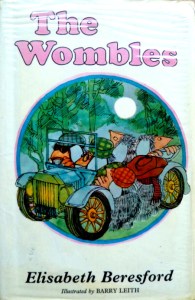 The Wombles by Elisabeth Beresford, 4/5
I may be twenty years older than the target audience, but I still enjoyed reading this charming British children’s classic.
[Why I read it: I recognized the title while browsing in the thrift store.]
The Illustrated Gormenghast Trilogy
 Titus Groan, Gormenghast and Titus Alone by Mervyn Peake, 3/5
Possessing the writing style of an orphan love child of J.R.R. Tolkien and Charles Dickens, Peake sees the world through rotting-salmon colored glasses and creates a gloomy trilogy that is, for all its sprawling imaginativeness, unsettlingly grim and ghastly. Perhaps readers who are less sensitive to words’ connotations, sounds, and tastes would be less disturbed, but I was continually galled by Peake’s preference for off-putting, unpleasant language. The opening paragraph alone contains several good examples: the castle of Gormenghast is surrounded by “mean dwellings that swarmed like an epidemic around its outer walls” and one of its towers, “patched unevenly with black ivy, arose like a mutilated finger from among the fists of knuckled masonry and pointed blasphemously at heaven.”
So what, you might think, he’s just describing a creepy old castle. But no, almost everything is treated similarly. A candelabrum is “like a vast spider suspended by a metal chord,” a character’s teeth are like “two brand new rows of gravestones,” the morning sky is “awakening air quilled with blood,” and a lone cloud is “like a wing ripped from the body of an eagle.” Almost all of the characters are portrayed repellently and most posses gross names such as Rottcodd, Mr. Flay, Swelter, Steerpike, Nannie Slagg, Doctor Prunesquallor, Lord Sepulchrave Groan, Sourdust…and many more. It is not often that a reader is presented with so many characters and so few of them likeable.
The first two novels are partly redeemed, in my mind, by their vivid portrayal of many memorable characters and an imaginative setting for a plot that contains several exciting episodes and a few moving ones. I think the first two books are much stronger without the third, which was disjointed–almost incomprehensible at times–and ended poorly (it is not surprising to learn that it was cobbled together from the manuscripts of a dying author).
My review would not feel complete without mentioning Peake’s skilled illustrations, which were scattered generously throughout the text. It is so unusual to encounter an author who is capable of drawing what he writes (I always felt sorry for Tolkien in this respect). Also noteworthy is the author’s prodigious vocabulary. Between pages 309 and 793 (the trilogy is almost a thousand pages long, but it took me a while to realize that the strange words were going to keep popping up, then even longer to get tired of writing them down), I encountered no fewer than 23 very unusual words, 16 of which I am almost absolutely sure I’ve never seen in print before. For the curious, here are the 16 words with links to definitions: liana, canalized, spilth’d, daedal, abactina, lacuna, umbrageous, anile, cruddled, gracile, marcid, oriflamme, purdah, titivating, humus and mulcted.
[Why I read it: I enjoyed the BBC miniseries based on the first two books.]
 OmniRambles