
Tagged: fiction
Dracula
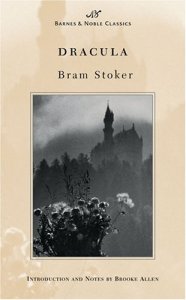 Dracula by Bram Stoker, 5/5
I expected this famous Gothic horror novel to be trashy and cheap, in the fun, readable way that characterizes (in my experience) even the lowest-quality literary output of the late 19th century. Though the characters lack depth and the book displays both offhanded sexism and instances of laughable sentimentality, it is much better written and more fun to read than I anticipated. The creation and build-up of suspense is handled skillfully and the plot is satisfying, with a good payoff. Stoker’s technique of telling the story through the diaries and letters of multiple characters generally works well, though he does not settle into a good rhythm in shifting between characters until Chapter 5. This chapter, with its abrupt switch from the excitement of the first four chapters, to comparatively boring and unconnected content from different characters’ points of view, marks the only dip in the book’s action. Dracula is definitely a page-turner: with only 50 pages left to read, I was equally excited to find out how the story would end and sad that it would soon be over.
Just a little research indicates the nausea-inducing amount of literary criticism this novel has been subjected to, with tortured psychological and sexual interpretations that are, to my mind, equal parts bull and shit. My reading of the book for pure enjoyment (surely the cause for which it was written), hinted at no undertones, overtones or, in fact, tones of any kind that would merit the overblown speculations that have been painstakingly read into the text by various scholars.
A note about this edition: the introduction, by Brooke Allen, provides a blow-by-blow synopsis of the book’s plot, a surprisingly common “sin” that I find both annoying (because SPOILERS!) and disrespectful to the author’s work.
[Why I read it: it’s one of those classics (like Shelley’s Frankenstein) that I have always meant to read. When I saw it on the shelf at the thrift store, I knew the time was right.]
Storm Front
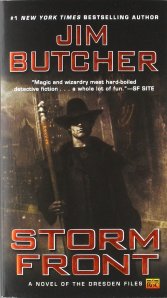 Storm Front: A Novel of the Dresden Files by Jim Butcher, 3/5
A delightful overload of classically cheesy clichés, straight from the detective fiction bible, was the only thing that made this book readable to me. I enjoyed the supernatural take on the whole private eye thing, and Butcher included some imaginative touches, but most of it felt pretty generic. Far more interesting than the plot was the [ultimately unanswered] question “Is Butcher purposefully mocking the detective fiction genre, or does he actually have a bona fide degree, carved in cheese, from the Nancy Drew School of Writing?”
While enjoyable, I don’t really feel any compulsion to read the rest of the books in the series.
[Why I read it: I thought the TV show looked interesting, but my books-before-movies rule required me to first give the books a try.]
Jam
 Jam by Yahtzee Croshaw, 4/5
I was tempted to give this book full marks just for the sheer audacity and originality of its jampocalyptic plot, but ultimately felt the whole affair a bit unsatisfying at the conclusion. I think this was because Croshaw introduced too much new stuff near the end of the book. This would probably have been less jarring if the rest of the book had not been so tightly focused on a more limited collection of characters and locations, leading the ending to feel a bit like it belonged to a different story. Also, I felt that, by the end, Croshaw had subtly crossed the line from mocking clichés to falling back on them. That said, it was still very entertaining, witty and “novel” in every sense of the word.
[Why I read it: I enjoy Croshaw’s sense of humour, having become familiar with it through watching his weekly game reviews and reading his first novel, Mogworld.]
When Did You See Her Last?
 When Did You See Her Last? by Lemony Snicket, 4/5
Like the first book in the series, Who Could That Be At This Hour?, this is very funny and quotable, but not very memorable as far as plot is concerned.
[Why I read it: I love Snicket’s snide sense of humour and the book was handy, since the kids had already ordered it from the library.]
Welsh Legends and Folk-Tales
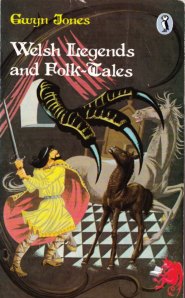 Welsh Legends and Folk-Tales, retold by Gwyn Jones, 5/5
These retellings are lively and witty, without pretension or rambling, and perfectly suited for reading aloud. It was especially interesting to read stories about King Arthur told from a Welsh perspective.
N.B. The Welsh pronunciation guide is rather unfortunately located at the back of the book, where you will encounter it after some 250 pages of incorrect mental pronunciation of names such as Blodeuwedd and Lleu Llaw Gyffes.
There are charming pen and ink illustrations by Joan Kiddell-Monroe at the beginning of each chapter. Also, fans of vintage C.S. Lewis and Tolkien books will undoubtedly recognise the name of illustrator Pauline Baynes, who did the cover art for this edition.
When I bought the book, I knew nothing about the author besides that, judging from the first name, there was a good chance she was Welsh. It turns out HE was Welsh and, in fact, a renowned scholar, writer, and translator of the Mabinogion (a collection of mediaeval Welsh myths). Gwyn Jones’ Wikipedia article is somewhat deficient, but I did find an interesting entry about him in Drout’s J.R.R. Tolkien Encyclopedia.
[Why I read it: I’m interested in lesser-known mythologies (especially those of the British Isles), so I picked this up at the thrift store for 99¢. The book felt like your average junky paperback and I was unfamiliar with the author, but seeing Pauline Baynes credited on the back cover really sold it to me, giving the book some class and authenticity.]
Ender’s Game
 Ender’s Game by Orson Scott Card, 5/5
The storyline is excellent, the characters interesting, the setting detailed and the writing skilled, but what has always struck me most favourably about this book is Card’s abnormally well-developed theories on the psychology of leadership and the natural, believable ways these theories are embodied in the characters he creates. The actions and motivations of the characters do not seem artificial or forced–Card avoids the contrived, stilted interactions and scenarios that many less skilled writers resort to when attempting to be “psychological.”
[Why I read it: I wanted a refresher of the book before submitting myself to the shallow spectacle, the hollow shell of any meaningful narrative, that will be, if current trends in the film industry are any indication, the movie version. I am not seeing it solely to complain, however (though that could surely be fun)–my brother is writing a short paper comparing the book to the movie and, since I teach him writing, I want to understand his thought process.]
The Best Tales of Hoffmann
 The Best Tales of Hoffmann by E.T.A. Hoffmann, 1/5
I found these rambling tales to be deeply boring and written in an off-putting, affected style. The first story, “The Golden Flower Pot,” (vaunted by the editor as Hoffmann’s best work) absolutely reeks of opium, full as it is of confusing dream sequences, hallucinations, inconsistent use of supernatural elements, and such oddities as a salamander exiled from “Fairyland Atlantis” to earth, in the form of an old man with daughters disguised as talking snakes. All that, but somehow, still boring and pointless.
Each successive story disenchanted me anew and it was toilsome work to get through the entire book. The only story I didn’t actively loathe was “Tobias Martin, Master Cooper, and His Men,” which is a sweet little tale whose lack of any real payoff or point is forgivable, given that it was inspired simply by a painting.
[Why I read it: the author’s name caught my eye as I browsed through books in the thrift store because, as a child, I had played a piano transcription of part of an opera called The Tales of Hoffmann, and I recognised his name from the song description.]
Twelfth Night
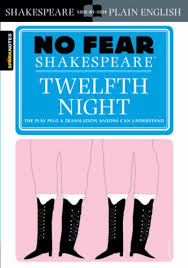 Twelfth Night by William Shakespeare, 5/5
This lighthearted and unrelentingly witty play is similar to As You Like It and A Midsummer’s Night Dream, but is my favourite of the three. While I find it distracting to see the modern version of the text side-by-side with the original, in this case, it really helped me to understand a lot of humour that would otherwise have gone right over my head.
[Why I read it: part of the aforementioned long-term mission to read everything by Shakespeare. I picked this copy up from the thriftstore.]
Tristram Shandy & A Sentimental Journey
The Life and Opinions of Tristram Shandy, Gentleman and A Sentimental Journey Through France and Italy by Laurence Sterne, 2/5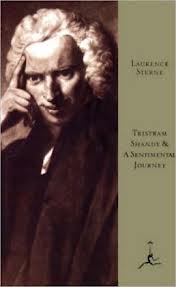
With its unconventionally rambling narrative and unsubtle innuendos, I am not surprised that this book created quite a stir in the 1700s. However, stripped of its shock value by modern times, Tristram Shandy seems to me little more than the idle fantasies of a bored and not especially talented hobby writer. There are a few quality passages (especially those involving the Widow Wadman) but overall I get the distinct feeling that Sterne just wrote whatever drivel came into his head and, if he had lived in modern times, would probably have been too busy re-watching old episodes of Lost to write at all.
[Why I read it: I’ve been meaning to read it for years, since first seeing it mentioned in C.S. Lewis’s Surprised by Joy:
For eating and reading are two pleasures that combine admirably. Of course not all books are suitable for mealtime reading. It would be a kind of blasphemy to read poetry at table. What one wants is a gossipy, formless book which can be opened anywhere. The ones I learned so to use at Bookham were Boswell, and a translation of Herodetus, and Lang’s History of English Literature. Tristram Shandy, Elia and the Anatomy of Melancholy are all good for the same purpose (142).
Also, many actors I like are in the movie version of the book, so I recently watched it, which led to my customary feelings of obligation to read the book (and feelings of guilt for not having read the book first).]
Knots and Crosses
 Knots and Crosses: An Inspector Rebus Novel by Ian Rankin, 2/5
This has about the same depth, complexity and uniqueness as the plot of an average episode of any old crime TV show. The story unfolds in a way that leaves the reader as clueless throughout as the main character seems to be and the ending feels rushed, with no real payoff. The most interesting part of the book was multiple appearances of the unusual word “outwith,” which is Scottish for “outside” or “beyond.”
[Why I read it: I enjoyed the first season of Rebus (a TV show based on Rankin’s literary character) but the show did a complete cast reboot for the second season and I didn’t like the new actors (or the new writers and director, for that matter) at all. While reading reviews, looking for some commiseration, I was surprised that several people liked the new series because they felt it was truer to the books’ portrayal of the character. Realising I was one of those annoying people who have an opinion on the movie but have never even read the book, I hastened to remedy the situation and was punished for my sins with the first novel, which so failed to inspire me to read any more books in the series that I can’t even imagine how it inspired a TV show.]
 OmniRambles