
Tagged: book review
Zombie Spaceship Wasteland
Zombie Spaceship Wasteland: A Book by Patton Oswalt, 2/5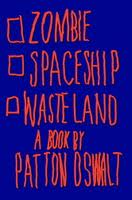
For some reason, I thought this was going to be a novel. It turned out to be a collection of anecdotes by a stand-up comedian. My favorite bit was the section containing hilarious descriptions of wines. Overall, there were some funny and imaginative word choices, but Oswalt’s humor in general struck me as forced, depressing and full of cultural references I didn’t understand (especially about books and music).
The Winding Road
The Winding Road by W. Edmund Hood and Ung Ho Chang, 2/5
I read this tiny, self-published book in one sitting. It was more compelling than the atrocious cover led me to expect (how are there still people who think cheesy, colored fonts, huge blocks of text and poorly Photoshopped images are ok?). The book tells the story of Ung Ho Chang, a South-Korean who survived war-torn post-WWII Korea and the Korean war to end up a U.S. citizen. The idea I found most thought-provoking was the fact that this man, a war refugee, army officer, spy, POW, and fireman got a job as a maintenance worker in a Top Food store in Seattle when he arrived in the U.S. It just goes to show that one can never know what someone else has gone through and even the most ordinary and unadmirable-appearing people might have a fascinating and impressive history.
How to Raise a Puppy You Can Live With
How to Raise a Puppy You Can Live With by Clarice Rutherford & David H. Neil, 3/5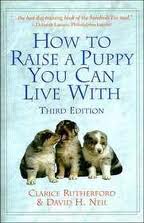
There are many similarities between this book and Cesar Millan’s, but this one is shorter and more efficient at communication. I like Rutherford’s common-sense, straightforward approach to puppy training.
How to Raise the Perfect Dog
How to Raise the Perfect Dog: Through Puppyhood and Beyond by Cesar Millan, 3/5
This is an entertaining and easy read, but not nearly as informative as watching Millan’s TV show.
Stage Fighting
Stage Fighting: A Practical Guide by Jonathan Howell, 4/5
This is an efficient, well-illustrated book. The most interesting thing I learned is the idea that, in order to create tension, the roles of victim and aggressor are reversed, as far as control of the action is concerned. For example, in a strangling scene, the aggressor is trying to pull his hands away from the victim’s throat, while the victim is trying to hold the aggressor’s hands in place.
Moneyball
Moneyball: The Art of Winning an Unfair Game by Michael Lewis, 3/5
This book left me more shocked at the overall inefficiency of the baseball industry than impressed by the Oakland A’s unorthodox success strategies. Lewis’s account felt lacking in focus and I couldn’t help wondering if the presence of a few logical entities in the baseball world was worth all the hoopla merely because they were surrounded by closed-minded morons.
On War
On War by Carl Von Clausewitz, 2/5
1. Be a genius. 2. All the other military theorists are wrong, wrong, wrong (and also, idiots). These two points quickly become tiresome as the main themes of this interminably long book. I have a pretty high tolerance for literature other people might consider boring, but this work really kicked my butt. Clausewitz makes some thought-provoking and tradition-challenging points, but for every useful bit of insight there are pages and pages about why no basic rules or principles can be applied to war, so the best idea is just to be a military genius who can magically measure all circumstances and eventualities and plan accordingly. Clausewitz draws from a very limited pool of military examples to illustrate his points and spends most of his time bashing the military theorists/strategists of the day (the book reads somewhat like a Facebook rant responding to the status “I <3 Jomini and Bulow”).
I have no doubt that, given time, Clausewitz would have polished this book into something more finished, consistent and useful, with less rambling, ranting and repetition. It is not his fault that he died too soon, leaving behind only a rough draft, but as it stands, I think he would be embarrassed to see his work published in this condition. While the work does have a lot of historical value, this is a rare case where I would advise would-be readers to save themselves a lot of pain by skipping the book and instead reading a good commentary and some thoughtfully-chosen excerpts.
Othello
Othello by William Shakespeare, 4/5
Well, this is pretty depressing. In Hamlet and Macbeth the villains at least have some redeeming humanity, but Iago is pure evil and his motivation is not well-enough established to make it believable to me. Also, Othello is an idiot. Besides that, it is very exciting and I enjoyed it.
Seven Pillars of Wisdom
Seven Pillars of Wisdom: A Triumph by T.E. Lawrence, 4/5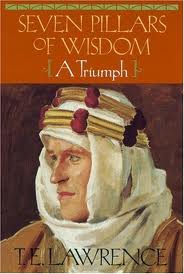
It’s a good thing I like being surprised, because this book first revealed, then blasted all the misconceptions of “Lawrence of Arabia” I’d somehow accumulated, picturing him as an England-hating, obnoxiously gay, stuck-up poser, whose main rebellious achievements were dressing in robes, getting impossibly tanned and prancing around on a camel. This impression was absolutely wrong and I finished the book with an opposite opinion, inspired by Lawrence’s toughness and unique mixture of confidence and self-deprecation. Somehow, he managed to live honorably while torn between loyalty to England and determination to keep her lightly-made promises to the Arab people. He valued intellectualism over all merely physical concerns, but a poetic nature, sense of humor and keen observational insights into humanity made him human and keep the book from being a dry military treatise. It reads more like an adventure story than anything and I was never bored, pretty amazing for a book about one of the few remaining topics that holds no interest for me – Middle Eastern culture and politics.
Guards! Guards!
Guards! Guards! by Terry Pratchett, 5/5
This book is brilliant and hilarious, as is usual for Pratchett. Especially enjoyable was the section satirizing cults.
 OmniRambles