
Tagged: book review
Amphigorey
Amphigorey, Amphigorey Also, and Amphigorey Again by Edward Gorey (try saying that three times fast), 5/5

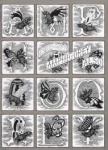
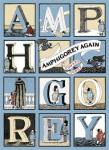
With a grim gaiety and chilling charm, every dark line in these three anthologies oozes originality and style. Gorey’s authenticity and consistency lend a strange sense of the inevitable to his oeuvre; at our first encounter, I thought, of course, this had to exist. Several of the stories are a little too disturbing for my taste, but I love the overall aesthetic and vocabulary. Any author who can make me run crying to a dictionary, two pages in a row (not to mention introducing me to what is perhaps the greatest sounds-like-a-swear-but-isn’t word of all time: subfuscous), is all right in my blog.
Books: A Memoir
Books: A Memoir by Larry McMurtry, 1/5
Disjointed. Random. And kinda boring (much like this review).
The Polysyllabic Spree
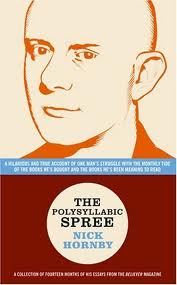 The Polysyllabic Spree: A Hilarious and True Account of One Man’s Struggle with the Monthly Tide of the Books He’s Bought and the Books He’s Been Meaning to Read by Nick Hornby, 3/5
Hornby’s modern taste in literature meant that I did not recognize most of the authors/books he mentioned, which limited my enjoyment of this collection of essays. Luckily, though, Hornby is reasonably witty and comfortingly honest about his shortcomings as a reader (one of which is forgetting almost everything he’s read), so the book was still reasonably entertaining.
Dodger
Dodger by Terry Pratchett, 2/5
This book was an unpleasant surprise from one of my favourite authors. Firstly (and, to be fair, Sir Terry Pratchett can hardly be blamed for this), I was wrongly anticipating a Discworld story. Discovering the long-awaited novel to be an isolated work of historical fantasy was depressing on two fronts, given that I have historically (and sometimes, hysterically) disliked the historical fiction genre. It is a rare author who can weave figures from the past into an original story naturally, without having them come across as prefabricated, connotation-burdened crutches.
In most respects, Dodger is the opposite of what I have come to expect from reading dozens of Pratchett novels. Usually, Pratchett’s stories have multiple, complicated plot lines but this effort has only one very thin, predictable one. Usually, the characters are surprising and unique but Dodger’s are relentlessly cliched (including racial stereotyping). Usually, Pratchett is hilarious and satirical but this book is not very witty and provides only a minimum of social commentary on Victorian London. I also noticed that Pratchett employs an uncharacteristically limited vocabulary, constantly re-using the same words, phrases and ideas. It is this last point that makes it seem that Dodger’s intended audience is slightly thick young adults, but it contains so many innuendos and mature themes that I couldn’t recommend it to my teenage sister.
Sadly, I wouldn’t recommend this book to anyone, not even a Pratchett fan. In fact, especially not a Pratchett fan, since it is so very disappointing in the context of his other, much better, books.
Split Self/ Split Object
Split Self/ Split Object: Understanding and Treating Borderline, Narcissistic, and Schizoid Disorders by Philip Manfield, Ph.D., 3/5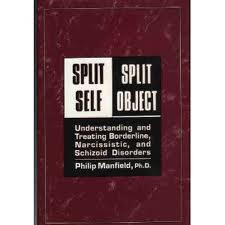
Knowing nothing about clinical psychology at the outset, I was surprised by how accessible this book, geared towards an audience of professional therapists, turned out to be. The language was not technical and the concepts seemed simplistic. Because of this, I have split feelings (haha) about it; on one hand, it was enjoyable to gain an understanding of general psychology concepts, but on the other hand, I was shocked that any practicing clinician would need a book this basic.
No matter what Manfield’s approach might suggest about the competency levels of some therapists, I read this in an attempt to gain the tools to understand myself a little better and it was a successful experience. Until now, my understanding of psychotherapy consisted of something vague about people who think they’re smart, generally wear glasses on the tips of their noses, scribble meaningfully on notepads while muttering tut tut and claim couches as business expenses. Now, I understand better that a therapist’s job is more to direct their client’s self-analysis than to intervene. My conclusion? Making people think is cool. Making yourself think is cooler. Challenge accepted.
Unbroken
Unbroken: A World War II Story of Survival, Resilience, and Redemption by Laura Hillenbrand, 5/5
Several people recommended this book to me, so naturally, I expected it to suck (following the observable and direct correlation between popularity and shitness… *ahem* 50 Shades of Grey, Twilight *ahem*). Given this [realistic, not pessimistic] expectation, I was first surprised to find myself not hating the beginning chapter, then shocked to find the rest of the book to be an extremely enjoyable page-turner. Not only does the story have enough drama and action for four movies, but it is based on a true account and is written sensibly. Hillenbrand doesn’t waste the reader’s time or make loads of obnoxious speculations about characters’ subjective feelings. The book is well-formatted, with pictures placed strategically throughout instead of in annoying inserts. The last time I was this surprised to love a book was War and Peace.
Lose It!
Lose It! by Charles Teague and Anahad O’Connor, 1/5
I love the Lose It! website (it’s helped me lose 30+ pounds) but this book has little to recommend itself. The info it provides is shallow and repetitive. The whole eat-a-normal-hamburger-every-day-instead-of-a-supersized-cheesy-one-and-you’ll-save-enough-calories-in-a-year-to-lose-5-pounds method of weight loss is not very convincing or motivating to me. The only reason to buy this book would be to support the free app and website. Everything you need to know can be found on the website, in the forums.
Ghostwritten
Ghostwritten by David Mitchell, 3/5
Sadly, this book is not written by British comedian David Mitchell, but by a less funny and much less sarcastic man of the same name. Nevertheless, I persevered in my reading because these very personal stories, narrated from the viewpoint of nine different individuals, are well-written, with a voyeuristic appeal. I admire how Mitchell gently weaves the accounts together, letting the reader discover the characters and events in common between them, instead of belaboring the connections. The main reason I didn’t give this book a higher rating is that I am unable to understand what the point of the whole thing is (and it’s not just that I’m too thick to “get” it – other reviewers seem equally unenlightened and even the book jacket was very vague in its description). The novel has the effect of a garment, beautifully embroidered and carefully sewn together, that cannot be worn because its random openings and panels don’t fit the human body.
The Third Eye
The Third Eye: The Renowned Story of One Man’s Spiritual Journey on the Road to Self-Awareness by T. Lobsang Rampa, 1/5
I quit. The author’s forward to the second edition, with its fishy protestations of innocence and honesty made me suspicious initially. 26 pages containing bizarre descriptions of Tibetan culture later, I finally Wikipedia-d the book and learned that T. Lobsang Rampa is actually Cryil Henry Hoskin, a very British, very crazy man who must have suffered an immensely boring life before becoming the host of a Tibetan monk’s spirit. I could think up more scathing things to say, but really, a man who has had a book dictated to him by his Siamese cat (Living with the Lama) obviously needs no further comment.
Words Like Loaded Pistols
Words Like Loaded Pistols: Rhetoric from Aristotle to Obama by Sam Leith, 4/5
Leith achieves a great balance with this book – he’s entertaining without being insulting, academic without being dry and analytical without being annoying. Where other writers might exhaustively dissect a piece of rhetoric at the cost of common sense and the reader’s patience (see How to Read Literature Like a Professor), Leith keeps his analyses to-the-point and useful. Less importantly, I enjoyed the English pop culture references – it was fun to see mentions of TV shows and celebrities that I love, but don’t get to share with anyone here.
 OmniRambles