The Heart is a Lonely Hunter

The Heart is a Lonely Hunter by Carson McCullers, 2/5

As with most modern literature, I didn’t “get” this and am having a hard time even finding reasons to justify the value of its existence.  The book was unfocussed at best, as well as being dark and depressing.  Some scenes resonated with me, but most of it left me wondering how McCullers could possibly have been motivated to finish writing it, or, once finished, imagine that anyone would be interested in reading it.

Exercise #17 (page 273)

This exercise was to write a parody of a favourite poet and also a cento (poem made from fragments of other poems).

Parody of Ogden Nash
When I say I hate you, I don’t mean
just a bit.
I hate you like I hate reading a really
sad obit.
That listlessly lists all the loved ones
left behind the recently died
And makes you wonder why said newly
departed wasn’t saintified.
You should know that my feelings for you
are much stronger.
If you think this couldn’t be true
because surely nothing could be
more distasteful than reading re
random dead people, you couldn’t
be wronger.
The inspiration for this angsty
abhorrence might surprise you,
fatale most femme –
I hate reading obituaries because it
always annoys me to find that you’re
not the star of them.

Cento of Emily Brontë
The starry night shall tidings bring
That Time is treasuring up for me
Not a sign of further grieving
(Such thoughts were tyrants over me!)

Glad comforter! will I not brave,
That from which it sprung – Eternity.
Three thousand miles beyond the wave
We’ll rest us long and quietly.

Compiled from the following poems: “The starry night shall tidings bring,” “A.G.A. to A.S.,” “A death-scene,” “Faith and despondancy,” “Anticipation,” “Death,” “Written in Aspin Castle,” and “Start not upon the Minster wall.”

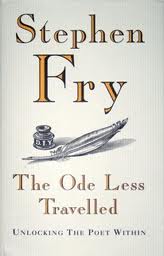
The Ode Less Travelled

The Ode Less Travelled: Unlocking the Poet Within by Stephen Fry, 5/5

This book is delightfully informative – it is impossible to be unaffected by Fry’s passion for poetry and gentle, self-deprecating humour.  Because I procrastinated on many of the 20 challenging poetry exercises Fry poses in this book, it took me about half a year to complete.  As a result of this, I am still basking in the self-satisfaction of successful completion.  NB: There are several rude/adult innuendos in the book, so I wouldn’t recommend it for young people in its entirety.

Exercise #18 (page 280)

This exercise was to write a haikus for each season, each including a kigo word (roughly, a reference to season, weather or atmosphere).

People seem to think
Spring is so fresh, bright and new.
All I see is mud.

That time of year when
Leisure outweighs the sweaty
Heat: it’s called summer.

The leaves flutter down,
Gracefully helpless in their
Seasonal descent.

Each home never so
Cozy as when the winter
Swirls coldly without.

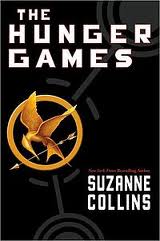
The Hunger Games

The Hunger Games by Suzanne Collins, 3/5

Skillful writing and an engrossing plot do not change the fact that this book is about children being forced to kill each other for other people’s entertainment. Collins tries to weasel out of this by framing the games as political oppression by an evil government, but the main focus throughout is on the entertainment aspect – people wanting the games to be exciting, wanting to see the violence, making bets on the winners, sponsoring the participants.  This begs the question, if the culture that bets on gladiatorial games involving children is so evil, what does that make the culture that enjoys reading books about the same topic?

Exercise #19 (pages 291-292)

This exercise was to write Petrarchan (abba-abba-cdccdc) and Shakespearean (abab-cdcd-efef-gg) Sonnets on Electoral Apathy.

Petrarchan Sonnet
The folks who love election day are few
They’ve little time to waste on candidates
And even less for all the running mates.
They’ve stuff to see and better things to do.
The TV shows that trap their eyes like glue
Are not the lengthy policy debates.
They’d rather whine and moan about “ingrates,”
Than research on and vote for someone new.
And yet, I am too hard (perhaps) on all
Who do not hear the ballot’s siren song,
Who view each promise made as just a tall
Tale – their hopes have lesser length to fall.
They care less when the leaders’ plans go wrong;
The dirty lies don’t fill their souls with gall.

Shakespearean Sonnet
They’d rather watch reality TV
And mindlessly invoke the party line,
Than learn about each candidate’s policies.
Their “research” is to read the roadside signs.
The responsibility they hold is great –
A right for which historic heroes died.
And yet, they’d rather leave to others their fate
Than give a hand and our great nation guide.
It pains me to admit I’m not above
This accusation, I too am apathetic
Too cynical to trust the promises of
The candidates, my choices are aesthetic.
And yet, perhaps, we’re wise to hate the game
Since every politician lies the same.

After the Funeral

After the Funeral (A Hercule Poirot Mystery) by Agatha Christie, 2/5

This book is fun, but not substantial, being short and populated with two-dimensional characters.  The twist at the end was entertaining, but I did not feel that it was very skillfully supported by the preceding plot development.  The whole thing gave me the impression that Agatha Christie had, by this time in her career, settled into a trustworthy and unique, if somewhat mundane and formulaic, writing style.  I would be interested to read some of her earlier works.

Exercise #20 (page 305)

This exercise was to write two pattern poems, one in the shape of a cross and another in the shape of a capital I.  Also, an acrostic verse spelling out your name.

This
icon
rich
with
deep symbolic meaning
is the plain wooden
board
upon
which
I pin
my sin.

Really, Fry?  It seems ridiculous
Of you to make me go to such a fuss.
Surely penning poems about my name
As such is just a narcissistic game,
Leaving others to suspect I find
In it more fun than yet has come to mind.
Not wishing folks to think me vain and dumb,
Denouncing it, I find the end has come.

Mirror, mirror on the wall
make me gracious dark and tall
life
long
mind
strong
eyes
bright
thoughts
right
make me charming rich and wise
And both my biceps a larger size.

The Wit’s Dictionary

The Wit’s Dictionary by Colin Bowles, 2/5

Some funny stuff scattered through a lot of unfunny stuff.  Also, very Australian, crass and surprisingly anti-Christian.  I would suggest reading Ambrose Bierce’s The Devil’s Dictionary and giving this book a pass.

Black Hawk Down

Black Hawk Down by Mark Bowden, 5/5

I think this is a masterpiece of war journalism for several reasons.  Firstly, Bowden treats his sources with respect and courtesy instead of manipulating and abusing them for the sake of furthering his own career.  This is not as common an attitude as I would wish and expect.  Secondly, it is clear that the accuracy of his portrayal is Bowden’s main concern.  He wastes no time searching for a sensational “angle” and doesn’t create unnecessary drama.  Thirdly, Bowden clearly recognizes the limits of his own expertise, refraining from sweeping allegations and extrapolations with regard to political and military strategy.  He is intelligent enough to avoid turning an admittedly controversial story into a personal soapbox.  Fourthly, the book is scrupulously well cited, with an annotated bibliography and detailed information provided on the sources.