
Category: Book Reviews
Wind, Sand and Stars
Wind, Sand and Stars by Antoine de Saint-Exupéry, trans. by Lewis Galantiére, 4/5
The stories in this book, based on Saint-Exupéry’s experiences as an airmail pilot and member of the French Air Force, are beautifully told – the product of a poetic soul. His bravery, adventures, eloquent love of the desert and romantic point of view remind me of a sort of French version of T.E. Lawrence. While the book is very enjoyable and quotable (occasionally even enlightening), Saint-Exupéry’s patronizing post-modernism results in a lack of intellectual/philosophical depth that makes itself increasingly felt as the book unfolds.
Marathon
Marathon: You Can Do It! by Jeff Galloway, 3/5
This guide, which applies Galloway’s signature run/walk method to marathon training, is clearly the product of much expertise and experience on the part of the author, addressing a wide variety of helpful topics. While it wasn’t entirely convincing (I still really hate the idea of interrupting my runs with walk breaks), the concepts made sense and if I ever become injured or dissatisfied with my training progress, Galloway’s method is likely one of the first I would consider adopting.
Unfortunately, some serious flaws as a book affect the quality and utility of Marathon: You Can Do It! The first half contains multiple appearances of several identical or nearly identical sentences and paragraphs, making the text bloated and frustrating to read. Also, there is a notable lack of helpful diagrams and photos to illustrate key concepts (though the few charts that appear are good). This is a book that deserves to be updated and proofread by an editor who has eyes.
Amphigorey
Amphigorey, Amphigorey Also, and Amphigorey Again by Edward Gorey (try saying that three times fast), 5/5

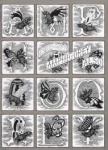
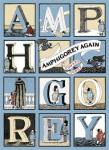
With a grim gaiety and chilling charm, every dark line in these three anthologies oozes originality and style. Gorey’s authenticity and consistency lend a strange sense of the inevitable to his oeuvre; at our first encounter, I thought, of course, this had to exist. Several of the stories are a little too disturbing for my taste, but I love the overall aesthetic and vocabulary. Any author who can make me run crying to a dictionary, two pages in a row (not to mention introducing me to what is perhaps the greatest sounds-like-a-swear-but-isn’t word of all time: subfuscous), is all right in my blog.
If on a winter’s night a traveler
If on a winter’s night a traveler by Italo Calvino, trans. by William Weaver, 4/5
It is with great mental pain that I write this review before consulting Wikipedia and Amazon ratings to find out what the heck this book is about. It would be easy enough to make up some intellectual-sounding drivel (too easy, in fact – If on a winter’s night begs for multiple interpretations) but I’d rather skip the college book report B.S. and nail down what will actually stick with me after this reading experience.
One of the most memorable aspects of this book is its mind-twistingly self-referential tone; Chapter One opens with “You are about to begin reading Italo Calvino’s new novel.” Of course, by the time I had read that, I was in the process of reading Italo Calvino’s new novel, not about to begin, which was just a taste of the surreal, logic-challenging, expectation-defying prose to come.
“The novel begins in a railway station, a locomotive huffs, steam from a piston covers the opening of the chapter, a cloud of smoke hides part of the first paragraph. In the odor of the station there is a passing whiff of station café odor. There is someone looking through the befogged glass, he opens the glass door of the bar, everything is misty, inside, too, as if seen by nearsighted eyes, or eyes irritated by coal dust. The pages of the book are clouded like the windows of an old train, the cloud of smoke rests on the sentences (10).”
Easy, you think, this is obviously a novel about novels. Yes, but no. It is also a novel about inspiration and the experience of reading. Or maybe, its incorporation of ten different, abortive sub-stories makes If on a winter’s night more of an un-novel about the relationships between reader and book, reader and writer, reader and reader, writer and book. Whether these are “correct” interpretations or not, this book resonated deeply with me, though perhaps more in the re-thinking of it than in the reading. In contrast to novels, which follow strict rules (whether acknowledged or not), life is a labyrinth of disjointed narratives, started without beginning and ending without resolution, a tantalizing journey at the end of which we will “arrive where we started / And know the place for the first time.” At least, I hope that’s the case. It is more likely that the end will find me rubbing my eyes hazily and reaching for the Wikipedia article.
Books: A Memoir
Books: A Memoir by Larry McMurtry, 1/5
Disjointed. Random. And kinda boring (much like this review).
The Polysyllabic Spree
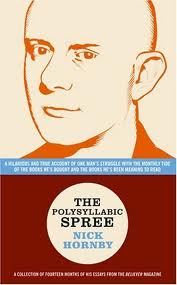 The Polysyllabic Spree: A Hilarious and True Account of One Man’s Struggle with the Monthly Tide of the Books He’s Bought and the Books He’s Been Meaning to Read by Nick Hornby, 3/5
Hornby’s modern taste in literature meant that I did not recognize most of the authors/books he mentioned, which limited my enjoyment of this collection of essays. Luckily, though, Hornby is reasonably witty and comfortingly honest about his shortcomings as a reader (one of which is forgetting almost everything he’s read), so the book was still reasonably entertaining.
Leviathan
Leviathan, or The Matter, Forme and Power of a Commonwealth Ecclesiasticall and Civil by Thomas Hobbes, 2/5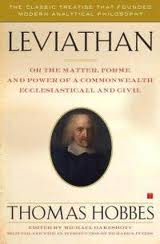
It took a couple years of Hobbes’ name consistently cropping up in books and conversation for me to get around to reading his sizeable, though by no means monstrous, Leviathan. Tommy is quoted often and respectfully, so I approached the book with a bias towards him, expecting to have my mind expanded, possibly to the point of explosion (Spinoza-style). The first chapter, which was all of two pages, took me a couple days to comprehend in any way, which seemed like an auspicious start, but sadly, once I became acclimated to the 17th century vocabulary and sentence structure, with its superabundance of semicolons, it didn’t take long for me to realize that Hobbes and I were not going to play well together. In fact, we clashed on an almost molecular level (if souls were made of molecules).
Where I had expected to encounter the radical and incisive mind of a bold hero of philosophy, I found instead a shattered old man, traumatized by civil war and clinging to futile modes of thinking. I realize that my limited life experience of uninterrupted privilege and safety does not put me in a position to make compelling criticisms, but it seems reasonable to think that maybe a man whose sole ambition in life is to avoid being slaughtered by his neighbors is not the best man to be speaking for his fellows and creating vast schemes of government and civilization. While Hobbes makes an admirably dogmatic case for the merits of abject slavery to absolute power, surely the evidence of history and testimony of every human being who has preferred death to subjugation, winning freedom at great personal risk, powerfully attests to the prevalence of an opposing set of values and beliefs. Hobbes may have worked out the perfect form of government and religion for people with the souls of slaves, but he leaves no room for people who desire more than physical safety.
NB. Reading Leviathan mostly consisted of manly slogging along, stifling groans of disagreement, so I feel only a little petty for pointing out the hilarity of the final chapters, where Hobbes starts to unravel, giving up even the pretence of logicality. It is a guilty pleasure to witness the man who denounces the usage of metaphor as one of four “abuses of speech” on page 21 then comparing the papacy to the “kingdom of fairies” and the Pope to “King Oberon” on page 543. Oh anti-Catholicism, you have never been so charming.
Ex Libris
Ex Libris: Confessions of a Common Reader by Anne Fadiman, 5/5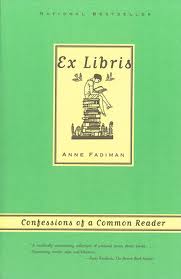
This is a charming collection of book-themed essays, written with delightful wit and insight. The essay on proofreading, which opened with Fadiman’s family gleefully pointing out typos in a fancy restaurant’s menu, was my favourite. Overall, the collection provided a welcome check to my exuberant ego since, smothered in the society of undiscerning devourers of cheap romances and bad fantasy, I tend to forget that there exist many readers who are better than I am (by which I mean, who read and retain more than I could ever hope to).
Dodger
Dodger by Terry Pratchett, 2/5
This book was an unpleasant surprise from one of my favourite authors. Firstly (and, to be fair, Sir Terry Pratchett can hardly be blamed for this), I was wrongly anticipating a Discworld story. Discovering the long-awaited novel to be an isolated work of historical fantasy was depressing on two fronts, given that I have historically (and sometimes, hysterically) disliked the historical fiction genre. It is a rare author who can weave figures from the past into an original story naturally, without having them come across as prefabricated, connotation-burdened crutches.
In most respects, Dodger is the opposite of what I have come to expect from reading dozens of Pratchett novels. Usually, Pratchett’s stories have multiple, complicated plot lines but this effort has only one very thin, predictable one. Usually, the characters are surprising and unique but Dodger’s are relentlessly cliched (including racial stereotyping). Usually, Pratchett is hilarious and satirical but this book is not very witty and provides only a minimum of social commentary on Victorian London. I also noticed that Pratchett employs an uncharacteristically limited vocabulary, constantly re-using the same words, phrases and ideas. It is this last point that makes it seem that Dodger’s intended audience is slightly thick young adults, but it contains so many innuendos and mature themes that I couldn’t recommend it to my teenage sister.
Sadly, I wouldn’t recommend this book to anyone, not even a Pratchett fan. In fact, especially not a Pratchett fan, since it is so very disappointing in the context of his other, much better, books.
The Privacy of the Self
The Privacy of the Self: Papers on Psychoanalytic Theory and Technique by M. Masud R. Khan, 3/5
The amount of material in these papers that I didn’t understand could fill a book…and it did. Since I only had The Privacy of the Self for a one-week interlibrary loan, I didn’t have the luxury of pondering and re-reading any of it (though it is somewhat debatable to what degree more time would actually have helped my comprehension). At any rate, I could only gain the most cursory understanding of the main points, leaving behind many difficult sentences such as the following classic: “The dissociation of such a primitive ego-ideal system, with its primitive id cathexes and archaic object-relationships, precludes ‘the process of integration and generalization’ (ibid., 1962), that is essential for the formation of a healthy ego-ideal” (197).
Despite the difficulty of much of the material, there were bits I was able to understand at some level and the case studies were interesting. Perhaps the best thing I got out of the book (besides the meaning of the fantastic word “aetiology”) was a better understanding of Freud’s value in a historical sense. I have always been deeply repulsed by Freud’s theories and reading his The Ego and the Id made me think of him even more as a human-shaped pile of bullshit. This opinion contrasted with Khan’s evident respect and admiration for the man. It was interesting to learn that Freud invented the very framework of the analytic setting and to understand that his attempts at self-analysis (whether successful or not) were both intellectual and admirable.
My main complaint about this book is that Khan quotes excessively from previously published sources and seems to have little to contribute that is original. The Privacy of the Self comes across as a sort of vain, self-published affair, that does not fit in the categories of scholarly writing or academic research. Perhaps this is an inevitable reflection of the controversial scientific standing of the whole theory of psychoanalysis.
 OmniRambles