
Tagged: book review
The Gun Seller
The Gun Seller by Hugh Laurie, 4/5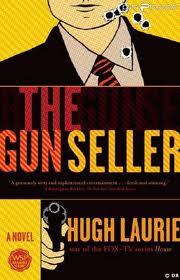
This book is action-packed and relentlessly witty.
True Grit
True Grit by Charles Portis, 4/5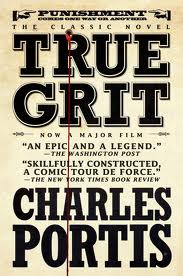
This short novel had only been published for one year before John Wayne appeared in a film version of it in 1969. Except for the ending, the book reads like a script for the movie, offering just a little more information and character depth than you can get from watching the film. I enjoyed reading it very much and am looking forward to reading more books written by Portis.
Wit
Wit: Humorous Quotations from Woody Allen to Oscar Wilde, Des MacHale, 4/5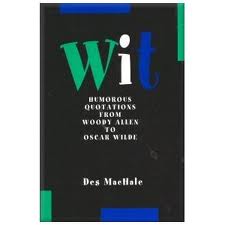
I needed some light reading after all that Spinoza and this book was perfect. I was impressed that there were so many quotes that I hadn’t seen in other compilations before. I laughed so hard at a couple of them that it brought tears to my eyes and I was afraid I’d wake up the sleeping kids. One of my favourites was “never buy a portable TV from a man who’s out of breath.”
The Essential Spinoza
The Essential Spinoza: Ethics and Related Writings, edited by Michael L. Morgan, 5/5
Writing in an uncompromisingly mathematical style, Spinoza undertakes to dismantle all conceptions and preconceptions about God, life, the universe and everything, painstakingly rebuilding his philosophy from a logical progression of definitions, axioms, propositions, proofs and corollaries and resulting in the most intellectually challenging work I have ever read. While there was much that I did not understand, there was also much that found immediate application to my own comprehension of God, religion, and existence. I was taken right out of my head by Spinoza’s approach to everything that matters to humans – it was like seeing through a one-way mirror after a lifetime of being on the reflective side.
Star Wars: Death Troopers
Star Wars: Death Troopers by Joe Schreiber, 2/5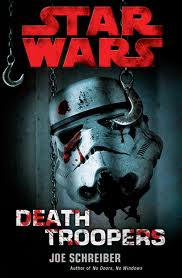
Think Star Wars meets Resident Evil and, flashing instantaneously and inevitably through your mind, will occur the setting, characters, plot and even specific scenes of Death Troopers. There are reasons the sci-fi, space exploration, Star Wars, zombie, and horror cliches are so popular and entertaining, and these same reasons are what make Death Troopers slightly more fun to read than could otherwise be reasonably assumed. It is, if not a great work of fiction, at least an interesting and entertaining example of commercialism and cliches in action. If the Star Wars franchise and its drooling fans didn’t exist, neither would this book, and I, for one, wouldn’t miss it.
The Filter Bubble
The Filter Bubble: What the Internet is Hiding from You by Eli Pariser, 4/5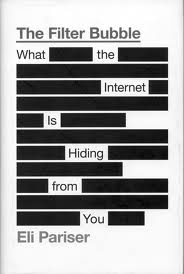
This book explores the ways that the increasing personalisation of the internet affects its users both in the short and long term senses. It also explores many other related issues, including the ethics of mass media, the psychology of advertising, the centralization of internet control, and the internet’s potential both to advance and harm the development of human society. I was very interested to learn that data about internet users is a huge and unbelievably valuable commodity for advertisers and that the gathering, buying and selling of this data is largely behind the scenes, with little accountability and opaque to public scrutiny. This book is scary and challenging, but not sensational or fluffy, as are most books of its ilk. I would have given it 5/5 if Pariser had been a little more scholarly with his handling of citations (there is a detailed “notes” section at the end, but the sources are sorted by chapter and not linked directly to the text, making it time-consuming to verify his claims). I recommend that everyone read this book. It will not be a waste of time.
The Ego and the Id
The Ego and the Id by Sigmund Freud, 1/5
While it is true that a greater knowledge of psychoanalysis and its specialised vocabulary, resulting from a familiarity with the rest of Freud’s writings, would no doubt increase my comprehension of his ideas, the pervasive odour of bullshit which oozes from between the pages of this eminently unscientific work encourage me rather to avoid all other products of Freud.
The Collected Poems of Langston Hughes
The Collected Poems of Langston Hughes, edited by Arnold Rampersad, 3/5
I know of no other poet who offers as much variety as Langston Hughes. His style ranges from elegantly traditional to vernacular, he writes about everything from music to politics, and the quality of his work spans from art to propagandist crap. In this large book, there were a handful of poems that I loved, many, many more that I appreciated, and dozens that seemed clumsy, preachy, sensationalistic, Communistic and agenda-driven. Hughes used his poetry very practically to fight against racism and other issues of the day (1920s-1960s), but there is a line at which art becomes propaganda which I think he frequently crossed. While I respect him for using his considerable talents in the causes of equality and justice, that doesn’t mean that I enjoy reading poetry that is tied up in politics and emotionally manipulative propaganda.
The Complete Idiot’s Guide to Understanding Football
The Complete Idiot’s Guide to Understanding Football by Mike Beacom, 2/5
This book was an entertaining read, but not nearly as informative as I had hoped. The shortage of diagrams/illustrations made it hard to understand formations and trick plays. The information was not presented sequentially – many terms were not explained at all or were explained at random points in the book. Also, the writing style was unfittingly panegyrical and subjective. For example: “It’s been said that Ginger Rogers could do everything Fred Astaire could do, only she could do it backward and in heels. Well, that’s how cornerbacks think of themselves compared to wide receivers – without the heels, of course” (166). Ha bloody ha.
War and Peace
 War and Peace by Leo Tolstoy, trans. by Constance Garnett, 5/5
I approached this classic with trepidation, having somehow got the notion in my head that it was prohibitively long and complex, and was shocked by how accessible and absorbing it really is. The scope of this book is staggering – it seems to cover every single aspect of the human existence, with an insight, skill and thoughtfulness that I am at a loss to describe and cannot praise enough. This book is touching, inspiring, challenging, informative and (despite the awkwardness in style that is inevitable in many translated works) is the best novel I have ever read.
 OmniRambles