
Tagged: Bible
The New Oxford Annotated Apocrypha
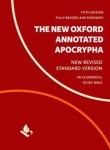
The New Oxford Annotated Apocrypha (NRSV 5th ed.), edited by Michael D. Coogan, 5/5
The Apocrypha is one of those literary works that is impossible to approach without some pre-conceived expectation, since the very name is steeped in mystery. Raised Christian, I cannot remember ever being explicitly told to avoid these noncanonical ancient writings, however they were not included in my Bible and I had a vague conception of them as useless at best, and untrustworthy at worst. At some point in my spiritual meandering, I started to suspect that the Bible may have been compiled by a bunch of card-carrying HOA Karens and maybe the Apocrypha was simply too fun and awesome to be included. At any rate, I expected to encounter bizarre prophecies, entertaining stories about Jesus as a child, and lots of enticing, controversial ideas.
Not for the first time, my preconceptions turned out to be wildly inaccurate. I was surprised to find that most of these ancient writings fit pretty clearly and uncontroversially into the categories of history, storytelling, or praise, and, while I enjoyed reading these works, the Bible feels complete to me without them. My favorite book was Sirach, with its deeply relatable and often snarky proverbs. There were a couple quotes that I wished were in the Bible, but it was clear from context that Ben Sira had a lot of his own ideas and issues to work through. Overall, I found the Apocrypha to be a fascinating and occasionally inspiring collection of historical writings, regardless of any Biblical associations.
Why I read it: My husband was listening to the Book of Enoch and it sounded so wild that I wanted to check it out for myself. I just assumed it was in the Apocrypha and didn’t realize it wasn’t until I was about 80% done. Next stop–pseudepigrapha, I guess.
We Who Wrestle with God

We Who Wrestle with God: Perceptions of the Divine by Jordan B. Peterson, 4/5
A good indicator of Truth with a capital T is that the insights it produces expand the mind and effortlessly illuminate even the darkest corners of a topic, where lesser conceptions fear to tread. There are not many corners more dark than the blood-soaked, primal tales of the Old Testament around which Peterson’s bold and wide-ranging existential exploration occurs. More than just an in-depth character study of God, as revealed through crucial episodes of the Old Testament, this substantial work explores our relationship with the intangible realities of existence on both an individual and societal level, and the codification of these eternal truths into our oldest and most meaningful stories.
Free of the timeworn arguments and vocabulary of Christian apologetics, Peterson’s approach is sure to earn him a “straight to hell” label from many (and not just fundamentalists). I will admit to feeling an uneasy chill, that only others with a religious background would likely understand, at the language of the last couple paragraphs in particular. I won’t go into detail, though, because given the context of the previous 500+ pages, I believe the issue is merely evidence of the author’s tendency to follow a train of thought wherever it may lead, even if it means committing the sin of entering new, unexplored territory in what is supposed to be concluding material. Speaking of sins, I must comment on the astounding number of typos and errors this book contains–by far the most I have ever encountered in a published work. Hopefully these will be rectified in future editions.
Lest I end this review on a sour note, let me re-iterate how amazed I am that a work so broad in scope could be, at the same time, incredibly nuanced. There is something inspired about Peterson’s perspective, which allows him to dissect the most challenging and abstract aspects of the human experience without killing its joy and mystery.
Why I read it: I was curious about Peterson’s theological beliefs, and trusted that he would have an interesting and intellectual approach to the topic.
17th Century Bible Concordance
I was recently lucky enough to be allowed to examine a 17th century Bible concordance. The main language is German, but it also contains a lot of Latin and Hebrew, each language having its own distinctive typeface. A paper insert states that “This book was edited by M. Friederich Lancfishen and published at Leipzig and Franchfurth by Johann Heinrich Richtern in 1688. It was printed before the invention of the cylinder type press, from a wooden press which operated on the screw principle.”
Click the photos for captions with more information.


![The patron of the book, the "most serene prince and lord, Lord Frederick, Duke of Saxony." According to the signature, this artwork was created by J. Sandrart, who actually has his own [short] Wikipedia page. http://en.wikipedia.org/wiki/Joachim_von_Sandrart](https://i0.wp.com/omnirambles.com/wp-content/uploads/2013/06/goodimg_2804.jpg?w=366&h=581&ssl=1 "goodIMG_2804")


[Why I read it: belongs to a friend of a friend.]
 OmniRambles