Alex & Me

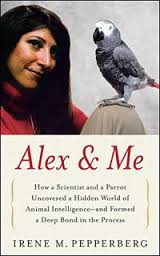
alex and me irene pepperbergAlex & Me: How a Scientist and a Parrot Uncovered a Hidden World of Animal Intelligence–and Formed a Deep Bond in the Process by Irene M. Pepperberg, 2/5

Readers looking for more than a heartwarming animal story will be disappointed by this relentlessly unscientific book.  Pepperberg spends more time complaining about being unappreciated by the scientific community, blatantly anthropomorphizing her parrot and giving unsubstantiated anecdotes of Alex’s human-like behaviour than providing anything of academic interest.  I was annoyed right from the beginning of the punishingly emotive first chapter, which is all about the emotional trauma that Alex’s death caused the author.  Pepperberg appreciatively quotes a letter from a lady who said the parrot’s demise caused her as much grief as the death of her only child, even though this long-distance sympathiser had never even met Pepperberg or Alex!  Now that’s just crazy talk, but the author treats it as a matter of course.  While some interesting comments are made about the model/rival method of teaching (where the learner observes two trainers interacting), no satisfying explanation is given of the time between Alex being taught, with difficulty, his first word and Alex spontaneously spouting grammatically correct, complete sentences in response to complex social scenarios.  Given Pepperberg’s credentials, I can only assume that she is a legitimate scientist, but this book is not at all convincing.

[Why I read it: frustratingly, this book has been sitting by my bed for so long that I can’t even remember why I ordered it from the library in the first place.   I think it might have been mentioned in some other book I read.]

Daniel Deronda

daniel deronda george eliotDaniel Deronda by George Eliot, 4/5

This novel is unexpectedly strange and deeply psychological–not at all your typical 19th-century fare.  The author flouts expectations in almost all aspects of the book, from the construction and flow of the plot, to the characters, their motivations and their relationships with each other.  Most immediately noticeable is the relative absence of the eponymous Daniel Deronda throughout the first half of the story; instead, the author focuses extensively on Gwendolen Harleth, a flawed character who is as beautiful and vivacious as she is small-minded and self-centred.  Many of the character traits that a more romantic author, such as Jane Austen, would employ in the creation of a heroine are used by Eliot to create an anti-heroine whose faults are unsettling in their similarity to the virtues of, say, Eliza Bennet from Pride and Prejudice.  Likewise, Deronda, when he does make an appearance, is not at all the dashing hero you might expect but rather introspective, reserved and overly-conscientious.  His moral influence on Gwendolen makes for a uniquely uneasy relationship that is at once intensely meaningful and unusually platonic.  Other interesting characters abound, many possessing well-developed psyches that render them as complicated yet predictable as real life.

Another unusual aspect of this book is the author’s increasing focus on Jewish culture and Judaism in the second half.  Perhaps my general lack of interest in the topic made me more easily bored, but several of the theological and philosophical sections were difficult to get through with a good attitude and I found the Jewish characters to be a little flat and uncharacteristically (for the author) stereotypical.  Eliot seemed too eager to incorporate her extensive studies on the topic into the story, which came off as a bit academic and unnatural.  Also, the concept that an innate sense of national identity can survive in someone, independent of their upbringing, does not seem plausible to me and I felt the story suffered as a result of the author’s reliance on this idea.  All in all, though, this book is well worth reading and truly stands alone in its genre, though some of the unusual aspects that constitute its strengths also contribute to its weaknesses.

[Why I read it: I watched the BBC miniseries (because it had Edward Fox in it) and enjoyed it enough to want to check the book out.]

One More Thing

one more thing stories and other stories bj novakOne More Thing: Stories and Other Stories by B.J. Novak, 4/5

A great sense of comedic timing, a keen eye for observation and a healthy appreciation for the potential absurdity of the ordinary combine to make this collection of short stories, poems and miscellanea an entertaining and thought-provoking (but mostly entertaining) experience.  My favourite story was probably “The Man Who Invented the Calendar” though “The Girl Who Gave Great Advice” was also hilarious.  If Novak writes more, I will definitely read more.

[Why I read it: Book Guy Reviews’ enthusiastic write-up of this book was convincing.]

Which Lie Did I Tell?

which lie did i tell? more adventures in the screen trade william goldmanWhich Lie Did I Tell? More Adventures in the Screen Trade by William Goldman, 4/5

This substantial follow-up to the hilarious, brilliantly-structured Adventures in the Screen Trade focuses rather more on the trade and less on the adventures, a fact that will please those looking for practical insight into the realities and technicalities of screenwriting, but perhaps disappoint those looking for pure entertainment.

This book is packed with information, opinions and examples, but there are three basic concepts that remain with me most vividly a few days later:
1. Screenwriters should enter a scene (and by extension, the story) as late as possible.  Scenes should generally be crafted to communicate as concisely and efficiently as possible, taking every opportunity to utilize context and subtext without wasting time on the page.  I know this is probably the first thing you learn in Screenwriting 101, but it was a novel concept to me.
2. Directors are overvalued and writers are undervalued.  Goldman is not unbiased on this point, of course, but there is a lot of evidence that directors often receive excessive, exclusive praise for aspects of a film that were almost entirely the result of someone else’s work.  For example, a writer can create a powerful scene, specifying every detail from the timing to the camera angles, but once filmed, the scene becomes inextricably tied to the director.  The example Goldman uses is the famous crop duster sequence in Hitchcock’s North By Northwest.  It is clear from the script that Hitchcock contributed almost nothing, creatively, to the scene, but what was the writer’s name?  I certainly don’t remember.
3. Protect the spine at all costs.  Goldman believes that every story has a spine–an irreducible core that should not be altered, no matter how much the surrounding details might change.  I thought it was fascinating how, in his example, he boiled each vital part of a book down into one word, creating a short list of essential words that drive the story.  His goal, when translating a book to film is to find and preserve the intent of the original material, which allows a great deal of latitude in how the peripheral aspects are treated.  This idea will provide much food for future thought whenever I encounter films based successfully or, more likely, unsuccessfully on books.

[Why I read it: I enjoyed Goldman’s first book, Adventures in the Screen Trade, very much.]

A Guide for the Perplexed

a guide for the perplexed e f schumacherA Guide for the Perplexed by E.F. Schumacher, 4/5

Decrying modern science and philosophy’s complete inadequacy to answer such endemic existential questions as “What does it all mean?” or “What am I supposed to do with my life?”, Schumacher creates a short but convincing argument for a more spiritual approach to life that transcends fact-based logic and the “nothing-but-ness” that characterizes modern thinking.

The backbone of the book is Schumacher’s categorization of “levels of being” into four vertical dimensions and the human experience into four “fields of knowledge” as follows:

Four Levels of Being:
Mineral = m
Plant = m + x
Animal = m + x + y
Man = m + x + y + z
(Where m=physical existence, x=life, y=consciousness and z=self-awareness)

Four Fields of Knowledge:
I–inner; that is, “what do I feel like?”
The world (you)–inner; “what do you feel like?”
I–outer; “what do I look like?”
The world (you)–outer; “what do you look like?”

As I understand, Schumacher basically argues that the mysterious, fundamental differences between levels of being, which science is unable to explain or reproduce, are evidence that life is bigger than logic and man is more than a favorable arrangement of atoms and random chemical reactions.  He points out that by allowing science to overstep its bounds by making philosophical, ontological claims, and by limiting philosophy to proof-based, rigorously logical, “dead” arguments, human existence is robbed of richness and mankind renders itself unable to realise its full potential and humanity.  According to Schumacher, an enlightened person who believes that “the slenderest knowledge that may be obtained of the highest things is more desirable than the most certain knowledge obtained of lesser things” (3) is more equipped to deal with the many and varied divergent problems in life (“divergent” meaning polarizing issues for which logical solutions are difficult or impossible to find).

Despite a powerful opening, I found some parts of the book to be unconvincing and outdated; also, I was hoping to find something a bit more practically helpful than being told that happiness and a rich, fulfilling life can be achieved by cultivating the four fields of knowledge and striving towards levels of being above myself.  However, the whole effect was undeniably challenging and uplifting–it is refreshing to read a philosophical treatise written to the end of ennobling man and celebrating the mysterious, temporary and fragile existence we each call life.

[Why I read it: I enjoyed Schumacher’s philosophy much more than his economics in Small is Beautiful, so this book sounded appealing.]


It’s Not About the Shark

its not about the shark david nivenIt’s Not About the Shark: How to Solve Unsolvable Problems by David Niven, Ph.D., 3/5

Everyone likes a good story and this book is full of them, from Steven Spielberg’s broken mechanical shark to the unintuitive results of a psychological study involving marshmallows and SAT scores.  However, the point of the book is ostensibly to enlighten, not just entertain, and this is where the weaknesses start, in my opinion.  Every couple of anecdotes, Niven stops to draw conclusions and give tips about problem solving which tend to be counter-cultural and surprising, such as “when you are stuck, find a good distraction that takes you away from your problems” (22) or “don’t follow the leader…[who] in many cases is just the person with bad ideas who has been around the longest” (182).  These tips are generally supported by two or three cherry-picked examples or studies and represent a gross oversimplification and overly-broad application of psychological findings.  For example, just because doctors in a study who were given candy made more accurate diagnoses doesn’t necessarily mean “eat a candy bar” is helpful advice (though, in case you needed an excuse to break your diet, this advice can be found on page 40).

[Why I read it: I think my friend Joy mentioned it, but I’m not sure.  I also had a good feeling about the author’s name, which I thought I recognized, but it turns out I was thinking about a different David Niven (the English actor).]

The Design of Everyday Things

design of everyday things don normanThe Design of Everyday Things: Revised and Expanded Edition by Don Norman, 2/5

This soporific book is a sort of spiritual antithesis to Brian Hayes’ Infrastructure: A Field Guide to the Industrial Landscape: while the latter opened my eyes to the surprising truth that good writing can make even the most seemingly boring topic an absolute delight, the former reveals that other styles of writing can make even the most interesting topic a dreary chore to read about.  And the topic is interesting: who hasn’t felt like an idiot when struggling with an object that was created without regard to the principles of human-centered design (I’m thinking of you, shower faucets at a friend’s house)?

Following the author’s preface, which revels unbecomingly in the previous edition’s alleged popularity, influence and inspiring effect on readers, comes pages and pages of unmemorable text about the “seven stages” of this and “three levels” of that–a sort of flow-chart in prose (almost as tedious to read as you might imagine).  Interesting examples of good and bad design feel few and Norman seems to spend more time criticizing designs than offering any creative solutions.  For example, he repeatedly states that one human mistake should never be enough to cause a catastrophe in, say, a chemical processing plant, but he doesn’t give many realistic ideas for how a sufficiently complicated, resilient system, run by humans could actually live up to his criteria.

All in all, it is difficult to say what it is about Norman’s writing style that grates on me so strongly.  He is the kind of author who briefly mentions a subject, then stops to tell you that more info can be found about it online (which is already reasonably obvious), then goes on to say that you could use Google to find the info (who doesn’t?), and then gives you the specific words you should use in Google to find the information, being sure to remind you to use quotation marks around your search phrase (we get it already!  Google it!).  In addition, I suspect that there is something about his general sentence formation that tends toward the mind-numbing.  It’s not that he uses difficult words or concepts, it’s just that I seemed to lose interest about three-quarters through many of his sentences.  I literally spaced out twice while reading the following gem and have still failed to process its main meaning: “Like prototyping, testing is done in the problem specification phase to ensure that the problem is well understood, then done again in the problem solution phase to ensure that the new design meets the needs and abilities of those who will use it” (229).  There, I zoned out again, mid-sentence.  It’s magical.

In the acknowledgments, Norman thanks his wife for telling him when he was “stupid, redundant, and overly wordy” (303).  Ironically, two-thirds of those words are ones I would still use to describe the book (in case you’re curious which two words, please know that the author is definitely not stupid).  Looks like Norman needs another wife or two.

[Why I read it: my friend, Joy, mentioned reading it in her book club and the topic sounded interesting so I ordered it from the library.]


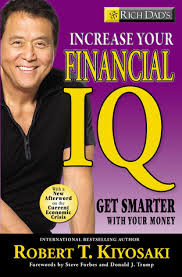
Increase Your Financial IQ

increase your financial iq robert kiyosakiIncrease Your Financial IQ: Get Smarter with Your Money by Robert T. Kiyosaki, 3/5

This book is a good follow-up to the too-anecdotal Rich Dad Poor Dad because it provides a variety of practical details and observations that give the reader an increased understanding of Kiyosaki’s financial philosophy.  Some of his ideas make sense immediately (e.g. your house is not an asset, protecting your money with smart tax strategies, the power of information) but other concepts are still hazy to me (e.g. what is “leverage,” viewing bank loans as tax-free money).

Kiyosaki makes a couple of points that I found very depressing but illuminating.  First, he advocates working for a network marketing company in order to learn sales skills and how to build a business.  Network marketing gives me the creeping horrors and if that’s what it takes to be an entrepreneur, I might not be cut out for it.  Secondly, he quotes a friend who says “Entrepreneurs have two characteristics…ignorance and courage” (194).  This is a phenomenon I’ve noticed in many areas of life, not just business-building.  It’s the blindly optimistic and self-confident who go out and do things successfully, not necessarily the people with real talent or skills.

[Why I read it: Kiyosaki doles out the info pretty thinly in his books and you need to read a few to get a handle on his ideas.]

Graham Crackers

graham crackers chapmanGraham Crackers: Fuzzy Memories, Silly Bits, and Outright Lies by Graham Chapman, compiled by Jim Yoakum, 4/5

This strange little compilation of miscellaneous writings by the late Graham Chapman (of Monty Python notoriety) is entertaining and provides some welcome insight into the inner workings of one of England’s funniest groups of writers.

[Why I read it: I found it in the thrift store.]


The ABC’s of Property Management

abcs of property management ken mcelroyThe ABC’s of Property Management: What You Need to Know to Maximize Your Money Now by Ken McElroy, 2/5

This book contains practical information and advice in quantity and quality commensurate with a mere introduction to a book titled The ABC’s of Property Management. The author seems much more interested in scaring readers into hiring a professional property management company than in providing any information of real value.  The main point I got out of the book was that property managers need to be very assertive people because they are required to ruthlessly screen prospective renters and to nickel and dime their renters to the absolute limit (which limit is established by calling the competition every month to gather information while posing as an ordinary shopper).

[Why I read it: I’m trying to increase my knowledge of personal finance by reading books in the “Rich Dad” series, starting with Rich Dad Poor Dad.]