
Category: Reviews
The Filter Bubble
The Filter Bubble: What the Internet is Hiding from You by Eli Pariser, 4/5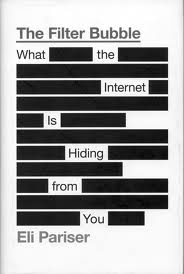
This book explores the ways that the increasing personalisation of the internet affects its users both in the short and long term senses. It also explores many other related issues, including the ethics of mass media, the psychology of advertising, the centralization of internet control, and the internet’s potential both to advance and harm the development of human society. I was very interested to learn that data about internet users is a huge and unbelievably valuable commodity for advertisers and that the gathering, buying and selling of this data is largely behind the scenes, with little accountability and opaque to public scrutiny. This book is scary and challenging, but not sensational or fluffy, as are most books of its ilk. I would have given it 5/5 if Pariser had been a little more scholarly with his handling of citations (there is a detailed “notes” section at the end, but the sources are sorted by chapter and not linked directly to the text, making it time-consuming to verify his claims). I recommend that everyone read this book. It will not be a waste of time.
The Ego and the Id
The Ego and the Id by Sigmund Freud, 1/5
While it is true that a greater knowledge of psychoanalysis and its specialised vocabulary, resulting from a familiarity with the rest of Freud’s writings, would no doubt increase my comprehension of his ideas, the pervasive odour of bullshit which oozes from between the pages of this eminently unscientific work encourage me rather to avoid all other products of Freud.
The Collected Poems of Langston Hughes
The Collected Poems of Langston Hughes, edited by Arnold Rampersad, 3/5
I know of no other poet who offers as much variety as Langston Hughes. His style ranges from elegantly traditional to vernacular, he writes about everything from music to politics, and the quality of his work spans from art to propagandist crap. In this large book, there were a handful of poems that I loved, many, many more that I appreciated, and dozens that seemed clumsy, preachy, sensationalistic, Communistic and agenda-driven. Hughes used his poetry very practically to fight against racism and other issues of the day (1920s-1960s), but there is a line at which art becomes propaganda which I think he frequently crossed. While I respect him for using his considerable talents in the causes of equality and justice, that doesn’t mean that I enjoy reading poetry that is tied up in politics and emotionally manipulative propaganda.
The Complete Idiot’s Guide to Understanding Football
The Complete Idiot’s Guide to Understanding Football by Mike Beacom, 2/5
This book was an entertaining read, but not nearly as informative as I had hoped. The shortage of diagrams/illustrations made it hard to understand formations and trick plays. The information was not presented sequentially – many terms were not explained at all or were explained at random points in the book. Also, the writing style was unfittingly panegyrical and subjective. For example: “It’s been said that Ginger Rogers could do everything Fred Astaire could do, only she could do it backward and in heels. Well, that’s how cornerbacks think of themselves compared to wide receivers – without the heels, of course” (166). Ha bloody ha.
War and Peace
 War and Peace by Leo Tolstoy, trans. by Constance Garnett, 5/5
I approached this classic with trepidation, having somehow got the notion in my head that it was prohibitively long and complex, and was shocked by how accessible and absorbing it really is. The scope of this book is staggering – it seems to cover every single aspect of the human existence, with an insight, skill and thoughtfulness that I am at a loss to describe and cannot praise enough. This book is touching, inspiring, challenging, informative and (despite the awkwardness in style that is inevitable in many translated works) is the best novel I have ever read.
The League of Extraordinary Gentlemen
The League of Extraordinary Gentlemen: Black Dossier by Alan Moore and Kevin O’Neill, 1/5
This graphic novel substituted sex and nudity for plot, so I didn’t even finish it. Also, in comparison to Watchmen the lettering was harder to read and the artwork lifeless.
The Film That Changed my Life
The Film That Changed my Life: 30 Directors on Their Epiphanies in the Dark by Robert K. Elder, 5/5
Two things must accompany the reading of this book, besides an appreciation of the more technical side of films: immediate access to imdb.com and an empty list entitled “Films to watch.” For me, this was a good introduction to many iconic directors with whom I am regretfully unfamiliar and a fascinating glimpse into how others watch, enjoy and are influenced by a variety of films. An example of the book’s power… after reading the interview about Citizen Kane, I am inspired to re-watch the movie (despite hating it the last three times I saw it). The only thing I didn’t like was the inevitable inclusion of spoilers for many of the movies.
The Ninja Handbook
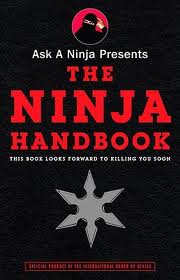 The Ninja Handbook by Douglas Sarine and Kent Nichols, 4/5
If you have a somewhat violent and immature sense of humour (and even if you don’t like Ask A Ninja, with whom this book is affiliated) you will enjoy this funny guide that takes you from a “Level 1 Nonja” to a “killersapien” fully worthy of “ninjaship.”
Watchmen
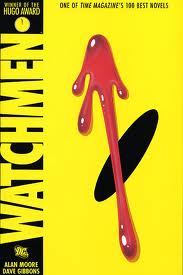 Watchmen by Alan Moore, Dave Gibbons and John Higgins, 5/5
The first graphic novel I’ve ever read, this work displays an impressive synthesis of art and prose, along with an interesting storyline, complex characters and variety of presentation.
Firefly
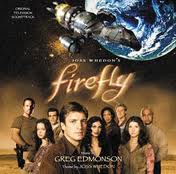 Well, I just finished watching Firefly and quite enjoyed it, with only a few caveats.
Likes:
1. The characters were interesting and displayed some development as the series progressed.
2. The SFX were more than acceptable – better than some shows now (I’m thinking of Eureka in particular), which is especially remarkable given that Firefly was from 2002. The only exception would be all the battle scenes from Malcolm and Zoe’s back-story. For some reason, those felt really cheezy.
3. Some of the writing was downright excellent, with occasional one-liners that were laugh-out-loud funny. I especially appreciated the way that “native” languages and colloquialisms were incorporated (mostly successfully) into the script. Also, the writers somehow managed to use poor grammar to good effect.
4. I liked the music in general (especially the unusual use of fiddles) but thought the theme song was a little tacky and unprofessional sounding.
5. The acting was quite good in general, with even some memorable performances from auxiliary characters, such as the bounty hunter in the last episode.
6. I liked how the makers didn’t let the futuristic setting take over – instead of trying to make every aspect of the show feel futuristic, they kept it to a more familiar-but-different level. For example, the kitchen in Serenity was very homey…but then you realise that it’s on a space ship.
7. The season was very cohesive – there were references to the events of past episodes and the writers’ main goal didn’t seem to be to make episodes that would simply stand on their own.
Dislikes:
1. I passionately hated Kaylee and her stupid “romance” with stupid Simon. Seriously – could she be any more obnoxious? In fact, almost all of the sexual tension in Firefly seemed really cliche, predictable and poorly executed.
2. Serenity is hideous looking – possibly the ugliest space ship I have ever seen. It looks like an arthritic, pot-bellied praying mantis.
3. I know that some will argue that the whole “space western” thing is what makes the show unique, but I think that, while fun, the western themes made the show unrespectable. It felt like they were looking for something cheap and handy that would utilize an excess of western props – a cop-out.
4. At times, the cinematography was absolutely horrid. In one scene in the first episode, I actually stopped and went back to see if my computer had glitched out or something, but no – the shoddy cuts and disorienting voice overs were built in.
In conclusion, my main reaction is surprise that this show was canceled. It seems superior to many other popular scifi shows and, if it continued, I would watch it.
 OmniRambles