
Category: Book Reviews
There is a God
 There is a God: How the world’s most notorious atheist changed his mind by Antony Flew with Roy Abraham Varghese, 2/5
This book succeeds in a purely biographical sense, but is weak in the area of apologetics which, in this case, mostly consist of lengthy quotes from sources that Flew found convincing, strung together with stilted prose. Given the depth of the subject and the limited length of the book, Flew was unable to give the numerous quotations the individual context they needed in order to be convincing, so I found myself continually questioning the true validity of his points. While I trust his expertise as a philosopher, I simply could not understand most of his philosophy-related references and, since I don’t trust him as a scientist, his numerous science-related claims seemed dubious.
Ultimately, reading this book just made me realise (not for the first time) what a true genius C.S. Lewis was.
The Aeneid
 The Aeneid by Virgil, trans. by Robert Fitzgerald, 5/5
This book would not have sat by my bed, unread, for so long if I had known that it was a spin-off of the Iliad, which I adore. Because I expected The Aeneid to be dry and boring (if even comprehensible), it was a fantastic surprise to suddenly encounter the familiar story of the fall of Troy, told from the perspective of Aeneas, who was inside the city at the time. It only got better from there, with many epic wartime vignettes and memorable characters such as the tragic Dido and the courageous but despicable Turnus.
It’s been a while since I read Homer’s Iliad, but in comparison, Virgil’s style seems less remote and detached, with a more personal tone and conscious attempts to affect the reader emotionally. However, this could just be a reflection of the translation, which did seem a little too modern for my taste (at one point, a character even yells “bring it on,” a phrase that I would be surprised to learn has roots in Latin). This edition does have a useful glossary of people and place names but it would be greatly improved by added pronunciation guides and a foreword providing some historical context.
The Age of Magnificence
 The Age of Magnificence: Memoirs of the Court of Louis XIV by the Duc de Saint-Simon, selected, ed. and trans. by Sanche de Gramont, 4/5
If these memoirs are at all accurate, there never were more despicable, inbred, petty, spoiled, childish, disgusting excuses for humankind than those (the writer not excepted) that clotted the courts of Louis XIV in the early 1700s.
I’ll leave you with two excerpts so you’ll know I’m not exaggerating.
Portrait of the Grand Prieur:
…In debauchery, he had an advantage over his brother in that he was fond of both fur and feather [note: I have no idea what that means, but it sure doesn’t sound good]. Every night for the last thirty years he had been carried to bed dead drunk, and he was faithful to this custom until he died (103)…
Portrait of the Princess d’Harcourt:
…She was also a glutton, and those who invited her to meals despaired because she wanted to relieve herself as soon as she arose from table, but often did not have the time, so that she let fall behind her a train of filth (112)…
Rise and Fall of the Mustache
 Rise and Fall of the Mustache and Other Hawkeyetems by Robert J. Burdette, 1/5
Ah, the old saying is correct – you truly can’t judge a book by its cover (or its deliciously intriguing title). Luckily, I bought this one solely for its beauty, so I wasn’t too disappointed to find it filled with the most tediously mawkish writings I have ever suffered through. Well, technically not “through,” since I only read the first 150 pages before stopping to reconsider the meaning of life and the value of time.
Dashiell Hammett Complete Novels
 Dashiell Hammett Complete Novels: Red Harvest, The Dain Curse, The Maltese Falcon, The Glass Key and The Thin Man by Dashiell Hammett, 4/5
Simply put, this book is film noir and Hammett is perhaps the only writer who has defined both a literary and a film genre. His darkly twisted, crime-filled plots and the gritty anti-heroes narrating them are both oddly appealing and unsettling. But then, it’s always surreal to experience the origin of cliches, whether it’s watching The Godfather for the first time (I swear, half of all cultural references still come from that movie) or reading about the original Sam Spade putting his heels up on a desk and coolly surveying a gorgeous dame through a cloud of cigarette smoke.
Speaking of Sam Spade, I was fascinated by the sort of men consistently idealised in these novels, wondering if it was more a reflection of the author’s fantasies or his audience’s. At any rate, these stories made me suspect that perhaps all men secretly wish to be mysterious detectives – hard drinking, hard living, taking punches as well dealing them, living by their own codes while breaking others’, uncovering corruption, neutralising gangs and saving the beautiful, helpless ladies.
Of the five novels, my favourite was The Glass Key, mostly because of the epic badassness of its protagonist, Ned Beaumont, and the pleasingly archetypal supporting characters (and because there wasn’t a movie to be constantly comparing it to). Red Harvest was reasonably entertaining, while The Dain Curse was the weakest of the lot, in my opinion. Overall, I was surprised by the trashiness that was still evident despite these books’ age. I am sure they were considered incredibly racy and low-brow in the late 1920s/early 30s.
Mind Hunter
 Mind Hunter: Inside the FBI’s Elite Serial Crime Unit by John Douglas and Mark Olshaker, 4/5
This account of former F.B.I. special agent John Douglas’ involvement in the development of criminal profiling is fascinating, if [understandably] sensationalistic. It is rare for a book of this ilk to display satisfactory substance, so I was surprised to find that Douglas obviously had more successful cases in his repertoire than room to include them. He uses numerous examples to demonstrate the power of profiling to predict criminal characteristics and develop clever strategies for their capture and conviction.
Prior to reading this, my only exposure to behavioral science and criminal profiling was watching some 174 episodes of Criminal Minds, so I was curious to see how “real life” would compare. Shockingly, many of the stories told in this book are even more unbelievably dramatic and impressive than those written for TV. Much of the vocabulary and basic ideas present in the TV show seem to be authentic, though it was interesting to learn that profiling is used frequently to help convict criminals, not just capture them (the focus of the show).
Something that came up several times in the book was Douglas’ positive opinion of the death penalty, criticism of the parole system and doubt that certain criminals can ever be rehabilitated. These are certainly not politically correct opinions nowadays but, whatever the moral/ethical issues, it is impossible to not take seriously the point of view of someone who has witnessed human depravity and violence on a scale thankfully not experienced by the vast majority of opinion-holders.
I was moved and inspired by Douglas’ concluding comments on the subject of the problem of violent crime in the U.S. He thinks that the most effective solution will be a grassroots one, since “crime is a moral problem…it can only be resolved on a moral level” (374). It is a powerful observation that “in all my years of research and dealing with violent offenders, I’ve never yet come across one who came from what I would consider a good background and functional, supportive family unit” (375). Finally, I couldn’t help thinking of 1 Corinthians 13 (and indeed, the whole message of the gospel) when Douglas states that “what I truly believe is that along with more money and police and prisons, what we most need more of is love. This is not being simplistic; it’s at the very heart of the issue” (375).
Selected Stories of Philip K. Dick
 Selected Stories of Philip K. Dick, 5/5
When I found out that the movies Blade Runner, Total Recall, Minority Report, Paycheck, Next, and The Adjustment Bureau were all based on the writings of one man, I was metaphorically gobsmacked. When I reached the final line of the first short story in this collection, Beyond Lies the Wub, I was literally gobsmacked. These twisty, dystopian sci-fi plots are like nothing else I’ve encountered in literature. Dick is a genre-definer with an unorthodox mind and I am definitely going to read more of his work.
N.B. Most of these stories are completely clean. The only ones I wouldn’t feel comfortable recommending to young people are “A Game of Unchance,” “We Can Remember it for You Wholesale,” “Faith of our Fathers,” and “A Little Something for Us Tempunauts.”
The Unlikely Pilgrimage of Harold Fry
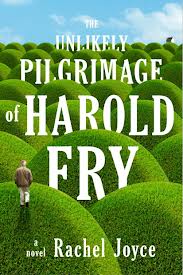 The Unlikely Pilgrimage of Harold Fry: A Novel by Rachel Joyce, 3/5
At the beginning of this book, Harold Fry is exactly the kind of old person I am terrified of becoming: boring and bored, belittled by his spouse, a stranger in his own house, living a life utterly without purpose and meaning. Fortunately for the reader, this all begins to change when Harold walks off one day to mail a letter to a dying friend, and just keeps walking.
I like the premise of this book, though the outworking of it seemed somewhat contrived and even gimmicky at times. Perhaps it was just the mood I was in (feeling overdosed with modern literature, which has never been my favourite genre), or perhaps it was the fact that this is the second “first novel” by a new author that I’ve read this month, but I sensed a self-consciousness and bleakness about the writing style which did not appeal to me. While it was not an unpleasant experience to read, this book did not find a home in my head and I shall probably forget all about it in about a month.
The Tempest
The Tempest by William Shakespeare, 3/5
This seemed much shorter, shallower and preachier than the other Shakespeare plays I’ve read and I didn’t feel much of a connection with any of the characters. Given the straightforwardness of the plot, I could see this making a much better theater experience than a reading one.
Mr. Penumbra’s 24-hour Bookstore: A Novel
 Mr. Penumbra’s 24-hour Bookstore: A Novel by Robin Sloan, 4/5
This book is like a cookiecutter shark: it’s exciting, difficult to put down once picked up and it glows in the dark (thus automatically raising its score by an entire point). The story is suspenseful, creative and entertaining, but the plot curve is weighted heavily towards the beginning, building tension up to an inevitably unsatisfying climax that takes place a mere 10 pages from the end of the book. No one had to tell me that this is Sloan’s first novel, but fortunately, its weaknesses seem to stem more from a lack of experience than a lack of skill.
Mr. Penumbra’s 24-hour Bookstore is noteworthy for being the most “modern” in tone of any novel I have ever read. For example, one of the characters works at Google and a fictionalised version of the company plays a huge role in the story. Topics that I am unfamiliar coming across in works of fiction, such as e-book piracy, computer programming and role-playing games, surprised me at every turn. There was even a reference to the webcomic xkcd.
Overall, Sloan does a great job of creating a believably current alternate reality but I suspect this book will not age gracefully. Who knows, though, perhaps I am wrong and in twenty years time it will have gained an added aura of nostalgia.
 OmniRambles