
Tagged: schizoid
The Empty Core
The Empty Core: An Object Relations Approach to Psychotherapy of the Schizoid Personality by Jeffrey Seinfeld, Ph.D., 4/5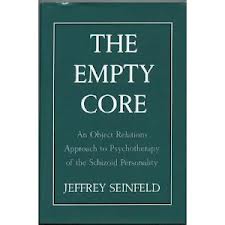
At first, the opacity of many sections of this book tempted me to take back my criticisms of the much simpler Split Self/ Split Object. The first chapter of this work, a short overview of object relations theory, could be the basis for an entire college course. Fortunately, the case examples made the technical material bearable and I find myself understanding much more as I look back over the content. Since this book is both difficult to understand and difficult to obtain (I had to get it through a two-week inter-library loan), I am writing a longer, more detailed review in order to help myself process and remember certain aspects of the book.
The title references a concept that I did not find easy to grasp at first, but later resonated with completely – the “empty core.” Seinfeld describes the schizoid experience of the empty core as “the uncrossable divide between the external and internal object worlds” (10). Since “instinctual drives are not complete in themselves but create, in the individual, a need for something external; they embody a sense of incompletion and lack” (8). One strategy schizoids use to cope with this feeling is “the effort to eliminate all need by maintaining himself as aloof, self-sufficient, isolated. Emptiness becomes an ideal. The individual strives toward extinguishing all need” (14). This sounds like someone I know and love…
Another concept in this book that I found fascinating and insightful is the idea that, as infants, we only experience ourselves through other people – seeing our reflection in them, which explains the human need for privacy:
“In existential phenomenological terms, the infant discovers its true self, which includes biological temperament, cognitive capacity, appearance, through the response of the other. The infant therefore discovers itself in the mode-of-being for others (Sartre 1943). The conception of being-for-others is analogous to the Kleinian idea of the infant becoming incorporated by the other and gives rise to comparable anxieties. In being for the other, the infant becomes aware of a lack of being-for-itself. It sees itself in its otherness, as object to the other’s subjectivity and endeavors to wrest back its subjectivity by the desire to flee from the sight of the other. To become invisible, to be unseen, is to annihilate one’s reflection in the eye of the other. This is the origin of the need for solitude and privacy, to make oneself into something more than what others perceive one to be” (37).
Reading this book did not consist entirely of “aha” moments of insight and clarity. For every compelling idea offered, there were paragraphs positively reeking of B.S., especially much of the content related to infant psychology and the mother/father as objects. I am aware that Seinfeld’s main purpose was to outline, not defend object relations theory, but many of the quotes and ideas he used came across outlandish, unscientific and unsupported. I was unsurprised to find Freud’s name and that of his followers connected to many of these theories.
Overall, though there was much that I disagreed with or didn’t understand in this book, it did reward my mental effort with some thought-provoking ideas and insights.
Split Self/ Split Object
Split Self/ Split Object: Understanding and Treating Borderline, Narcissistic, and Schizoid Disorders by Philip Manfield, Ph.D., 3/5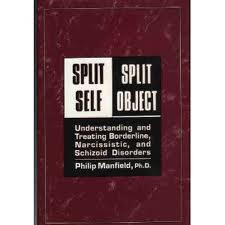
Knowing nothing about clinical psychology at the outset, I was surprised by how accessible this book, geared towards an audience of professional therapists, turned out to be. The language was not technical and the concepts seemed simplistic. Because of this, I have split feelings (haha) about it; on one hand, it was enjoyable to gain an understanding of general psychology concepts, but on the other hand, I was shocked that any practicing clinician would need a book this basic.
No matter what Manfield’s approach might suggest about the competency levels of some therapists, I read this in an attempt to gain the tools to understand myself a little better and it was a successful experience. Until now, my understanding of psychotherapy consisted of something vague about people who think they’re smart, generally wear glasses on the tips of their noses, scribble meaningfully on notepads while muttering tut tut and claim couches as business expenses. Now, I understand better that a therapist’s job is more to direct their client’s self-analysis than to intervene. My conclusion? Making people think is cool. Making yourself think is cooler. Challenge accepted.
 OmniRambles