
Tagged: fiction
Twilight Watch
 Twilight Watch by Sergei Lukyanenko,translated by Andrew Bromfield, 4/5
I’m glad I didn’t let the unlikeable second book in the Watch series put me off; this third book is very enjoyable and well written, back to the perspective of the original hero, Anton Gorodetsky.
[Why I read it: I’ve been reading this series off and on over the last couple months, starting with Night Watch.]
Dirk Gently’s Holistic Detective Agency
 Dirk Gently’s Holistic Detective Agency by Douglas Adams, 4/5
The plot was kind of all over the place and the characters were not well-developed, but nobody’s funnier than Douglas Adams.
[Why I read it: I’m a fan of Stephen Mangan, who played the title character in a funny TV version of the book series which put the books on my radar.]
Lud-in-the-Mist
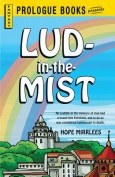 Lud-in-the-Mist by Hope Mirrlees, 5/5
This exquisite fantasy has a bittersweet and beautiful tune; I was entranced from the very beginning. More down-to-earth than George Macdonald’s Phantastes (one of the only books I can think of to which it is comparable), it expresses rather than evokes the mystery of human experience that C.S. Lewis describes as the “desire for our own faroff country” and the “inconsolable secret in each one of you” (The Weight of Glory).
Sadly, this atrocious edition is peppered with typos–even the front cover does not escape: in the book, residents of Lud-in-the-Mist are referred to as “Ludites,” not “Luddites.” Never did a typo bring along so many unfortunate and completely unrelated connotations.
[Why I read it: It appeared in very good company in the article “10 Forgotten Fantastical Novels You Should Read Immediately.”]
Daywatch
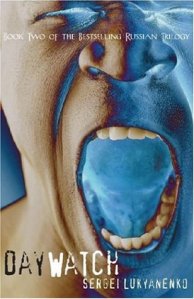 Day Watch by Sergei Lukyanenko, translated by Andrew Bromfield, 3/5
I really like the world Lukyanenko has created for this series, but a really graphic sex scene and lack of empathetic characters made this book less enjoyable than the first book in the series and one that I couldn’t really recommend.
[Why I read it: the first book in the series, Night Watch, was extremely well-written.]
Frankenstein
 Frankenstein: or, The Modern Prometheus by Mary Shelley, 4/5
Oooohhhhh, that “Shelley“! was my first and strongest reaction to this book. Frankenstein is well-written and maintains suspense throughout, but hinges, I thought, on a couple unconvincing plot devices: Frankenstein’s unwillingness to have a proper conversation with his monster and the monster’s quick descent into violence, neither of which made much sense to me.
[Why I read it: Another classic, like Dracula, that I should have read ages ago and finally picked up at the thrift store.]
Lady of the Mansion
 Lady of the Mansion (originally published as The Portent) by George MacDonald, 4/5
This short novel is beautifully written and imaginative. Without the happy ending tacked on as a concession to popular taste, it almost felt like a story-within-a-story from Macdonald’s Phantastes.
[Why I read it: I’m not usually a fan of Macdonald’s novels, but I saw this in the thrift store and was enticed by the laudatory reviews on the back cover.]
Night Watch
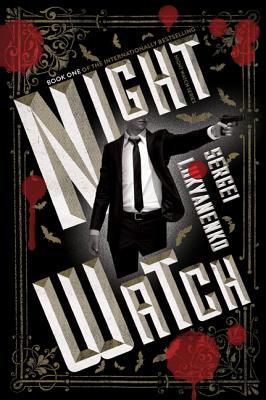 Night Watch by Sergei Lukyanenko, translated by Andrew Bromfield, 4/5
The three stories in this book are set in a fantasy version of Moscow that is home to both humans and the supernatural “Other” (magicians, vampires, healers and shape-shifters). Each Other chooses to be affiliated with either Light or Dark, living a life of benevolence or selfishness. The main character, Anton Gorodetsky, is a member of the Night Watch, a police-like entity composed of Light Others that monitors the behaviour of Dark Others, while the Dark Others in the Day Watch keep an eye on the Light.
Rather than pit the Light and Dark against each other in a cliched portrayal of the battle between Good and Evil, author Lukyanenko portrays the two Watches as functioning cooperatively, each side making concessions to the other in order to avoid an apocalyptic battle that would wipe out humankind (which is not in the interests of either side). Neither the benevolent actions of the Light Others or the malevolent actions of the Dark Others are unregulated–if one is allowed a kind action, the other is allowed a cruel one; balance is the key. Ultimately, the prevalence of one side or the other is determined by Humanity’s preference (an aspect of the story that seems weak–I hope it is elaborated on later in the series).
Lukyanenko explores the moral issues that arise in this counter-intuitive scenario, skillfully exploiting its dramatic potential. I appreciate how the author lets his characters’ interactions with the environment reveal how the fantasy world operates, rather than explaining everything in painful detail or using forced dialogue. The downside of this approach, and the fact that some nuances might be lost in the translation, is that a few parts of the stories are difficult to understand. Thankfully, the novel’s Wikipedia article provides very helpful summaries, which I referred to periodically in order to clarify some plot details.
I have to mention Gregg Kulick’s cover design for this HarperCollins edition–one of the most beautiful modern covers I’ve ever come across. If it were available as a poster, I’d be tempted.
[Why I read it: the confusing Russian films loosely based on this series did not inspire me to pursue it further, and it wasn’t until I recognised it in the i09.com list “10 Book Series So Addictive, You Never Want Them to End,” that I thought I’d give it a try. Part of the attraction was the claim that the series had a good ending, though I guess that point is moot now that a new book will be released in May.]
Grave Peril
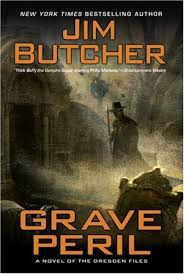 Grave Peril: A Novel of the Dresden Files by Jim Butcher, 2/5
This seems trashier than the previous novels and its vampire theme, though predating Twilight and the ensuing vampire craze, feels tiresome and unoriginal.
The Mabinogi
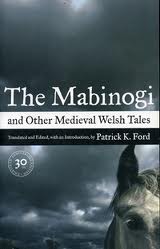 The Maginogi and Other Medieval Welsh Tales, translated and edited by Patrick K. Ford, 5/5
This scholarly translation is serious without being stuffy, making a great companion to Gwyn Jones’ more charming and humorous version.
Fool Moon
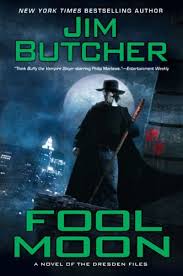 Fool Moon: A Novel of the Dresden Files by Jim Butcher, 3/5
I had not planned to read any more of the Dresden Files series after finding its first book, Storm Front, to be rather underwhelming. But I changed my mind after coming across a substantial number of comments and forum posts from fans who admitted the shortcomings of the earliest books and provided heartening assurances that the quality does nothing but improve as the series progresses. An unusual claim in this age of mindless sequels, but one that makes sense: if some authors explode onto the scene with First Novels of stunning perfection, many more must follow a flawed first offering with steady growth as a writer. Partly because I thought it would be fun to witness Butcher’s potential maturation as a writer and partly because I find the series’ premise appealing and enjoyed the TV show, I thought it would be fun to check out the second book.
While I did not feel that Fool Moon merited a higher rating of a whole number, it did seem more confident and less cheesy than the first book, even containing a passage or two that made me stop to appreciate a novel, well-communicated idea (all of which bodes well for the rest of the series). I could have happily done without the awkward sex scene and adult content sprinkled throughout in the drab, obligatory way that characterises both the modern novel and the movie desperate for a PG-13 rating. Perhaps that raciness is what characterises a “guilty pleasure” for others, but I would have felt guilty enough for reading a popular paranormal thriller when there is so much “serious” literature piled up by my bed.
 OmniRambles