
Tagged: fiction
Barchester Towers
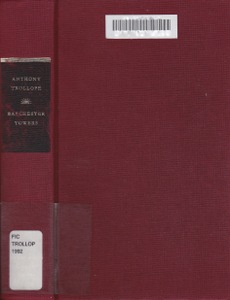 Barchester Towers by Anthony Trollope, 5/5
Simply put, this is one of the funniest and most entertaining books I have ever read; the characters, scenarios and author’s commentary (Trollope breaks the fourth wall frequently) had me laughing out loud throughout and I was sorry to reach the last page. Trollope’s delightfully fresh writing style and lack of idealized, stereotypical characters, combined with an unrelenting derision of organised religion’s faults make this novel stand out from others in its genre. The continuing trials of meek Mr. Harding, the romantic perils encountered by his widowed daughter, the clerical ambitions of hateful Mr. Slope, and a cast of other new and fascinating characters form a literary enterprise that is even more enjoyable than the first book in the series, The Warden.
[Why I read it: I enjoyed the first book in the series immensely.]
Death Masks
 Death Masks by Jim Butcher, 2/5
Many fans promise that Butcher only starts to hit his stride as the series continues, but I felt that this fifth book was generally less appealing than its predecessors. The plot was thin, the characters lacklustre and overall I felt it was missing that “so bad it’s good” quality that made the earlier books enjoyable. Also, there were a couple pages where the “adult tone” mentioned in the commendatory cover quote was a little too adult for me.
[Why I read it: sometimes I need a break from the 19th century literature and books on quantum physics.]
The Warden
 The Warden by Anthony Trollope, 5/5
This sweet little novel is about a mild churchman named Septimus Harding, whose quiet life and untested convictions are disrupted by scandal instigated by church reformer, would-be suitor to his daughter, and family friend, John Bold. The story is as simple as its characters, but this is no reproach: there is a sweetness and authenticity to Trollope’s style that charms and warms, while avoiding the over-sentimentality and contrivance that plagues much 19th-century literature.
[Why I read it: I seemed to encounter more Trollope novels on the shelves of bookstores in Hay-on-Wye than any other author (including Dickens), which made me curious.]
Alfred and Guinevere
 Alfred and Guinevere by James Schuyler, 3/5
This short novel is told exclusively through the conversations and diary entries of eponymous siblings. I am always suspicious of the words adults put into children’s mouths (they never seem quite authentic to me) and found this effort dull overall, despite a few amusing interactions. Also, the consistent lack of dialogue tags made it difficult to keep track of who was speaking. I could imagine this book appealing to some people, especially connoisseurs of literature featuring children, but it just didn’t interest me at all.
[Why I read it: While perusing actor Bill Nighy’s filmography, I came across the movie The Young Visiters (also starring the fantastic Hugh Laurie), which is rather unique in that it is based on a story written by a nine-year-old. I loved the movie and, while researching the story, read a review that also happened to mention Alfred and Guinevere very positively, making me want to read it.]
The Ocean at the End of the Lane
 The Ocean at the End of the Lane by Neil Gaiman, 3/5
This slim novel is an entertaining read (disturbing at times), but the storyline felt uncomfortably familiar, like a mash-up of The Princess and Curdie, a Miyazaki film and some Doctor Who episodes, with villains from Harry Potter and Lord of the Rings thrown in for good measure. I understand that there are only a few basic themes and archetypes that comprise most fantasy, but Gaiman’s story did not help me experience them in any way that seemed new or noteworthy, tending instead more toward the cliche and pat. Perhaps it merely betrays its origins as a short story, or perhaps I am sated with excellent fantasy, or perhaps I was just in the wrong mood–there are many reasons why I will give this famous author another try.
[Why I read it: My friend, Alison, enjoyed it and brought to my attention that I haven’t read anything by Gaiman yet (except his collaboration with Terry Pratchett: Good Omens).]
The Conan Doyle Stories
 The Conan Doyle Stories by Sir Arthur Conan Doyle, 5/5
While comparing my large book of Sherlock Holmes stories with my sister’s even larger book of Sherlock Holmes stories, I was recently disillusioned to discover that my edition was less comprehensive than I’d previously believed. So, when I saw the name of Conan Doyle emblazoned across the expansive spine of a ludicrously large book in Belle Books, Hay-on-Wye, I pounced eagerly. Strangely, the famous detective’s name was nowhere to be found inside.
A few months ago, if you were to ask me what Sir Arthur Conan Doyle had written, I would have replied Sherlock Holmes (of course) and some novel I’d dimly heard about but never read, called The Forgotten Land or something (actually, I just checked and it’s The Lost World). I would have been completely ignorant of the 76 short stories contained in this 1200-page book, which is approximately the size and weight of a cinder block (and just as unwieldly). Thrilled with my discovery, I vowed to fit it into my suitcase for the long trip home, no matter how many articles of clothing had to be sacrificed to make room.
Generally, I am not a big fan of the short story format; I resent the energy it takes to completely reset my brain for each new plot which, by the time it has spooled up to anything of interest, has inevitably neared its conclusion. But, delightfully, these stories all seemed to waste little time at the beginning and generally lasted just long enough to keep my attention. I found them to be skillfully written and impressive in their variety, ranging in genre from horror to humour to history. Iconic characters such as the great detective are nowhere to be found, but there is plenty to amuse, while some twists and turns kept me guessing right until the denouement.
[Why I read it: I was looking for books to bring on a recent, cross country road trip and this was in my to-read pile. It is so large as to seem an impractical travel companion, but while contemplating its vastness, I cracked it open and read this glorious sentence:
All this disquisition upon superstition leads me up to the fact that Mr. Manson, our second mate, saw a ghost last night–or, at least, says he did, which of course is the same thing.
I brought the book along without further hesitation.]
The Cider House Rules
 The Cider House Rules by John Irving, 2/5
The experience of reading my second John Irving book could not be more different than the first. Whereas I approached his A Prayer for Owen Meany with suspicion that changed to surprised delight, the glowing reviews and popularity of The Cider House Rules ill-prepared me for an unenjoyable story that left me feeling dirty and unsatisfied. There is no questioning Irving’s talent as a writer, but I found the book’s case for abortion to be repellently illogical and lazy, while the characters were mostly unlikeable and the adult content was disgusting (and, in my opinion, artistically unjustified).
[Why I read it: It’s famous, I enjoyed Irving’s Owen Meany, and a very likeable, intelligent person I met in Wales named it as one of his favourite novels.]
New Watch
 New Watch by Sergei Lukyanenko, translated by Andrew Bromfield, 4/5
I enjoyed this most recent addition to the Watch Series, told from the now-familiar perspective of Anton Gorodetsky. The author was successful in bringing in some new ideas/elements, though I did get a bit lost at the end of the story and had to consult Wikipedia.
[Why I read it: I’ve mostly enjoyed this series, starting with the first book, Night Watch.]
Last Watch
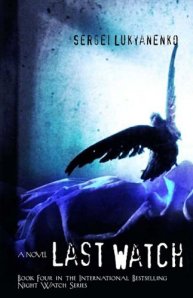 Last Watch by Sergei Lukyanenko, translated by Andrew Bromfield, 3/5
For some reason, I didn’t enjoy this book as much as the previous one. Perhaps some of the premise’s novelty has worn off for me, or perhaps the storylines just weren’t as engaging. I felt that Lukyanenko tried a bit too hard to include pop culture/literary references and I was annoyed by his appropriation of Merlin as a story character. The writing was decent, though there was some clumsiness in the first few pages that actually made me stop to check if the translator was the same person (it was). I didn’t appreciate the racy content, but it was nowhere as bad as Day Watch. Overall, a somewhat meh experience, but I’ll still be reading the fifth book in the series, as soon as it comes in at the library.
[Why I read it: I’ve been reading this series off and on over the last couple months, starting with Night Watch.]
Summer Knight
 Summer Knight: A Novel of the Dresden Files by Jim Butcher, 3/5
I much preferred this plot’s faerie angle to the last book’s vampire theme and, as an added bonus: no love interest. I might have dropped a couple IQ points while reading it, but probably no more than would have evaporated after a couple hours of watching TV sitcoms.
[Why I read it: Partly because the fans promise the series gradually improves, partly because I’m not in the mood for serious literature right now and partly because I’ve come to view the Dresden Files as an old pair of stained sweatpants–not something I’d show off in public, but pretty all right for days of lounging around and eating junk food.]
 OmniRambles