
Tagged: fantasy
Daywatch
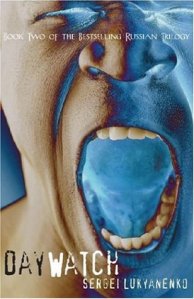 Day Watch by Sergei Lukyanenko, translated by Andrew Bromfield, 3/5
I really like the world Lukyanenko has created for this series, but a really graphic sex scene and lack of empathetic characters made this book less enjoyable than the first book in the series and one that I couldn’t really recommend.
[Why I read it: the first book in the series, Night Watch, was extremely well-written.]
Lady of the Mansion
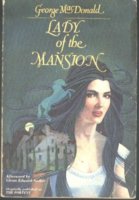 Lady of the Mansion (originally published as The Portent) by George MacDonald, 4/5
This short novel is beautifully written and imaginative. Without the happy ending tacked on as a concession to popular taste, it almost felt like a story-within-a-story from Macdonald’s Phantastes.
[Why I read it: I’m not usually a fan of Macdonald’s novels, but I saw this in the thrift store and was enticed by the laudatory reviews on the back cover.]
Night Watch
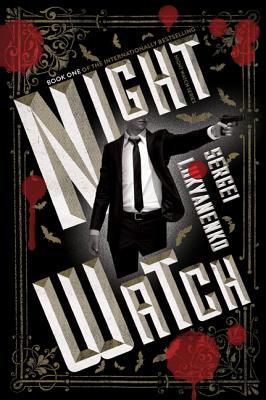 Night Watch by Sergei Lukyanenko, translated by Andrew Bromfield, 4/5
The three stories in this book are set in a fantasy version of Moscow that is home to both humans and the supernatural “Other” (magicians, vampires, healers and shape-shifters). Each Other chooses to be affiliated with either Light or Dark, living a life of benevolence or selfishness. The main character, Anton Gorodetsky, is a member of the Night Watch, a police-like entity composed of Light Others that monitors the behaviour of Dark Others, while the Dark Others in the Day Watch keep an eye on the Light.
Rather than pit the Light and Dark against each other in a cliched portrayal of the battle between Good and Evil, author Lukyanenko portrays the two Watches as functioning cooperatively, each side making concessions to the other in order to avoid an apocalyptic battle that would wipe out humankind (which is not in the interests of either side). Neither the benevolent actions of the Light Others or the malevolent actions of the Dark Others are unregulated–if one is allowed a kind action, the other is allowed a cruel one; balance is the key. Ultimately, the prevalence of one side or the other is determined by Humanity’s preference (an aspect of the story that seems weak–I hope it is elaborated on later in the series).
Lukyanenko explores the moral issues that arise in this counter-intuitive scenario, skillfully exploiting its dramatic potential. I appreciate how the author lets his characters’ interactions with the environment reveal how the fantasy world operates, rather than explaining everything in painful detail or using forced dialogue. The downside of this approach, and the fact that some nuances might be lost in the translation, is that a few parts of the stories are difficult to understand. Thankfully, the novel’s Wikipedia article provides very helpful summaries, which I referred to periodically in order to clarify some plot details.
I have to mention Gregg Kulick’s cover design for this HarperCollins edition–one of the most beautiful modern covers I’ve ever come across. If it were available as a poster, I’d be tempted.
[Why I read it: the confusing Russian films loosely based on this series did not inspire me to pursue it further, and it wasn’t until I recognised it in the i09.com list “10 Book Series So Addictive, You Never Want Them to End,” that I thought I’d give it a try. Part of the attraction was the claim that the series had a good ending, though I guess that point is moot now that a new book will be released in May.]
The Best Tales of Hoffmann
 The Best Tales of Hoffmann by E.T.A. Hoffmann, 1/5
I found these rambling tales to be deeply boring and written in an off-putting, affected style. The first story, “The Golden Flower Pot,” (vaunted by the editor as Hoffmann’s best work) absolutely reeks of opium, full as it is of confusing dream sequences, hallucinations, inconsistent use of supernatural elements, and such oddities as a salamander exiled from “Fairyland Atlantis” to earth, in the form of an old man with daughters disguised as talking snakes. All that, but somehow, still boring and pointless.
Each successive story disenchanted me anew and it was toilsome work to get through the entire book. The only story I didn’t actively loathe was “Tobias Martin, Master Cooper, and His Men,” which is a sweet little tale whose lack of any real payoff or point is forgivable, given that it was inspired simply by a painting.
[Why I read it: the author’s name caught my eye as I browsed through books in the thrift store because, as a child, I had played a piano transcription of part of an opera called The Tales of Hoffmann, and I recognised his name from the song description.]
Guards! Guards!
Guards! Guards! by Terry Pratchett, 5/5
This book is brilliant and hilarious, as is usual for Pratchett. Especially enjoyable was the section satirizing cults.
Snuff
Snuff by Terry Pratchett, 5/5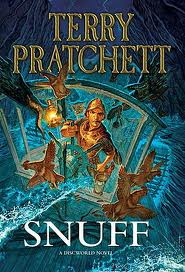
Pratchett’s latest is brilliantly hilarious, as always.
Reaper Man
Reaper Man by Terry Pratchett, 5/5
I read this book for my soul. It is meaningful, deep and rib-shakingly hilarious – everything I love about Terry Pratchett’s writing.
 OmniRambles